No more searching for fruit on the screen? AI at checkouts aims to speed up shopping
Coop is testing self-checkouts with artificial intelligence technology. The system recognizes fruits and vegetables when they are placed on the scale. It is also designed to detect situations where a customer does not scan a product.
Shopping is expected to be faster and generate fewer losses due to mistakes or theft.
Fot. Adobe Stock, licencja standardowa
The new solution is already operating in eight Extra stores, including on Grønland in Oslo. Coop is checking how customers will respond to the technology, which is intended to reduce the time needed to process weighed products from 20 to 5 seconds.
Kristian Bjørseth, head of payment services and in-store technology at Coop Norge, demonstrated the system for E24 using bananas as an example. The customer presses the product recognition option, places the item on the scale, and two cameras together with AI indicate the correct product.
Kristian Bjørseth, head of payment services and in-store technology at Coop Norge, demonstrated the system for E24 using bananas as an example. The customer presses the product recognition option, places the item on the scale, and two cameras together with AI indicate the correct product.
The checkout recognizes goods. Shopping should take less time
Coop points to convenience. According to the company, many customers choose self-checkouts because they are fast, and shortening shopping by an additional minute or two can be a competitive advantage. This is especially true for fruits and vegetables, where customers often have to search for the correct item on the screen.
The new feature aims to reduce this. The system displays a product suggestion after analyzing the camera images and scale data. In the demonstration, it recognized bananas. The customer did not have to scroll through the list or type in the product name.
The new feature aims to reduce this. The system displays a product suggestion after analyzing the camera images and scale data. In the demonstration, it recognized bananas. The customer did not have to scroll through the list or type in the product name.
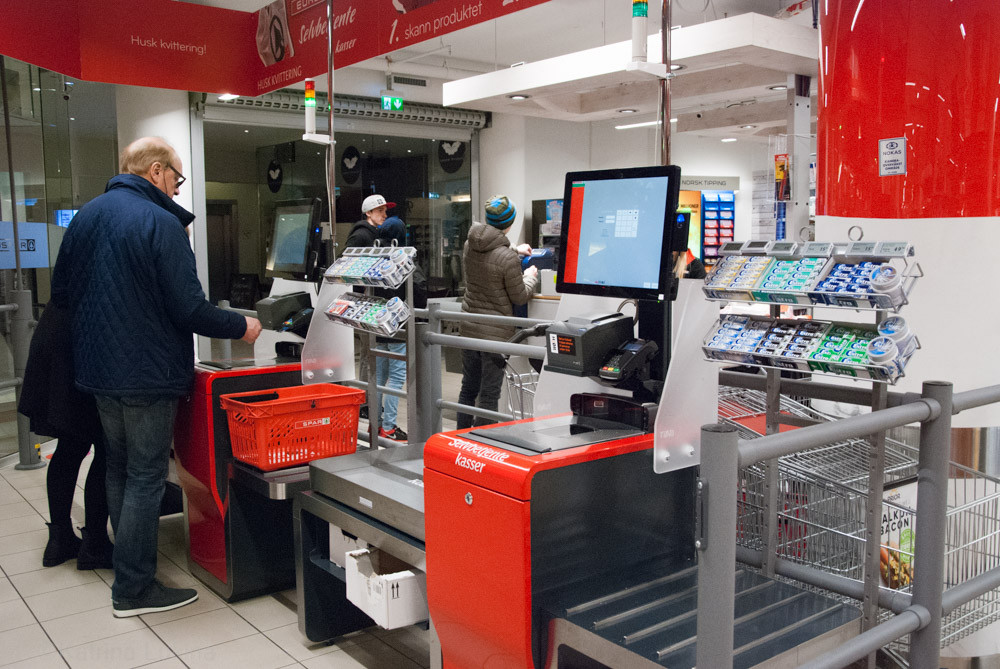
Shopping at self-checkouts is expected to become even more accessible.Photo: MN
Scanning errors. The system is designed to react immediately
The technology is also intended to reduce losses. Coop wants to detect both mistakes and deliberate omissions of products at the checkout. Bjørseth demonstrated this with a package of tomatoes, which he slid across the counter with the barcode facing up. After a moment, the screen displayed a message asking if the customer forgot to scan the item.
According to Coop, there are about 28,000 incorrect scans per day. Some of these may be theft. If the customer does not correct the error after the message, an employee will approach the checkout. Bjørseth emphasizes that the company assumes the possibility of an honest mistake and gives the customer a chance to correct it.
According to Coop, there are about 28,000 incorrect scans per day. Some of these may be theft. If the customer does not correct the error after the message, an employee will approach the checkout. Bjørseth emphasizes that the company assumes the possibility of an honest mistake and gives the customer a chance to correct it.
Installing the system requires two cameras for each checkout. Bjørseth admits that the technology is costly, so its implementation will depend, among other things, on the size of the store. It is not intended only for locations with the highest levels of theft. Smaller stores may not be able to maintain such a solution. Coop estimates that in a year, the system could be operating in a minimum of 200 and a maximum of 400 Extra stores. Currently, AI tools are being tested and trained.
How do you rate this article?