Bacon, sausages, and fish under scrutiny. New eating habits in Norway revealed
New data from Norway shows that processed meat remains a frequent part of the diet for a large portion of the country's residents. One in four people report eating products such as bacon, sausages, ground meat, or salami four to seven times a week. The highest consumption is seen among young adults.

Eating habits in Norway are not among the best.
stock.adobe.com/licencja standardowa
The data comes from the European Health Interview Survey (EHIS). It was published by Statistics Norway (SSB). The questions focused primarily on the consumption of red and processed meat. SSB reports that 25 percent of Norway's residents eat processed meat four to seven times a week. For red meat, the percentage is lower at 12 percent.
Young people choose processed meat most often. Age differences are very noticeable
The highest rate concerns people aged 16–24. In this group, 40 percent of respondents eat processed meat at least four times a week. The percentage decreases with age. Among those aged 80 and above, it is 12 percent, although SSB notes that the data for the oldest group is more uncertain.
A similar pattern is seen with red meat. Among the youngest adults, 18 percent report frequent consumption. In the oldest group, it is 3 percent. Researcher Elin Skretting Lunde from SSB points out that the differences between age groups are significant.
A similar pattern is seen with red meat. Among the youngest adults, 18 percent report frequent consumption. In the oldest group, it is 3 percent. Researcher Elin Skretting Lunde from SSB points out that the differences between age groups are significant.
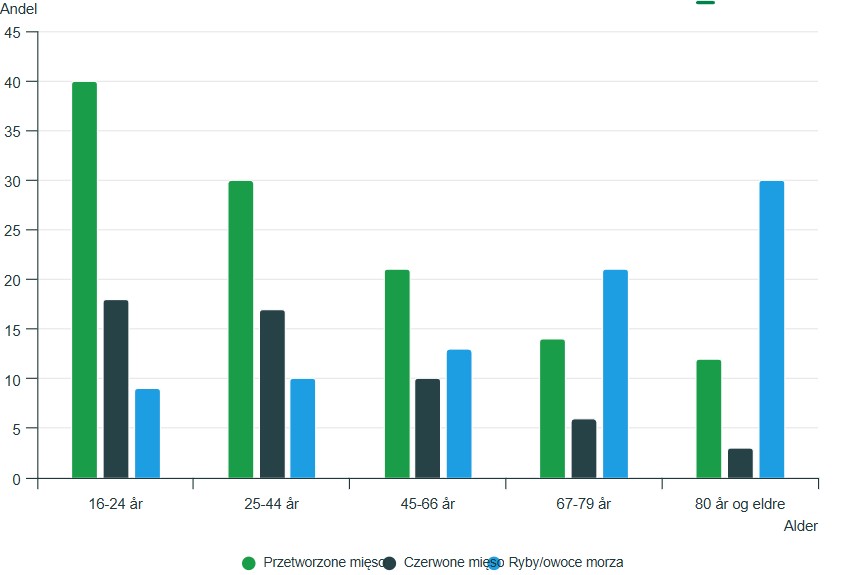
Percentage of people aged 16 and older who frequently (four to seven times a week) consume processed meat, red meat, and fish or seafood.Ill. SSB
Men are more likely to report eating meat. The pattern is different with fish
Men eat meat more often than women, according to SSB analysis. This applies to both red meat and processed products. In the 16–24 age group, half of men eat processed meat at least four days a week. Among women of the same age, it is about one third.
Fish and seafood consumption looks different. Only one in ten young adults eats them frequently.
The percentage increases with age. In the 80+ age group, 30 percent of respondents report eating fish and seafood four to seven times a week.
Fish and seafood consumption looks different. Only one in ten young adults eats them frequently.
The percentage increases with age. In the 80+ age group, 30 percent of respondents report eating fish and seafood four to seven times a week.
SSB also shows changes in other parts of the diet. In 2025, 55 percent of Norway's residents ate vegetables daily, and 41 percent ate fruit daily. The study shows that eating habits differ clearly by age and gender, and some old habits are gradually changing. Norwegians eat fish several times a week less often than before, and they also drink sweetened beverages less frequently, but processed meat remains a common choice, especially among young adults.
How do you rate this article?