Working after graduation in Norway? One trend is particularly noticeable
Employment among graduates in Norway remains high. In 2025, 88.6% of people aged 20-34 who had completed their education in the past 1-3 years and were not continuing their studies were employed. However, new data shows that fewer and fewer of them are entering professions that require higher education.
Education does not always help in landing your dream job in Norway.
Fot. Adobe Stock, licencja standardowa
The data comes from the Labour Force Survey (AKU), conducted by Statistics Norway (SSB). It covers people who have completed secondary school, higher vocational education, and university or academic studies. SSB indicates that the employment rate among graduates fell by 1.3 percentage points in 2025 compared to 2024. Despite this, the employment level remains high.
Employment is stable. However, Norway does not perform best
Between 2021 and 2025, graduates in Norway maintained a strong position in the labor market. SSB reports that there are no clear changes in their employment situation, although data from individual years show slight fluctuations. Unemployment is not increasing. Tonje Køber from SSB points out that most graduates are employed.
SSB compared Norway with other Nordic countries, Austria, and the Netherlands. Throughout 2021-2025, the Netherlands had the highest percentage of employed graduates, while the lowest levels were most often recorded in Finland and Denmark. The differences were noticeable. The largest disparities between countries amounted to about 11 percentage points in 2021 and 2025.
SSB compared Norway with other Nordic countries, Austria, and the Netherlands. Throughout 2021-2025, the Netherlands had the highest percentage of employed graduates, while the lowest levels were most often recorded in Finland and Denmark. The differences were noticeable. The largest disparities between countries amounted to about 11 percentage points in 2021 and 2025.
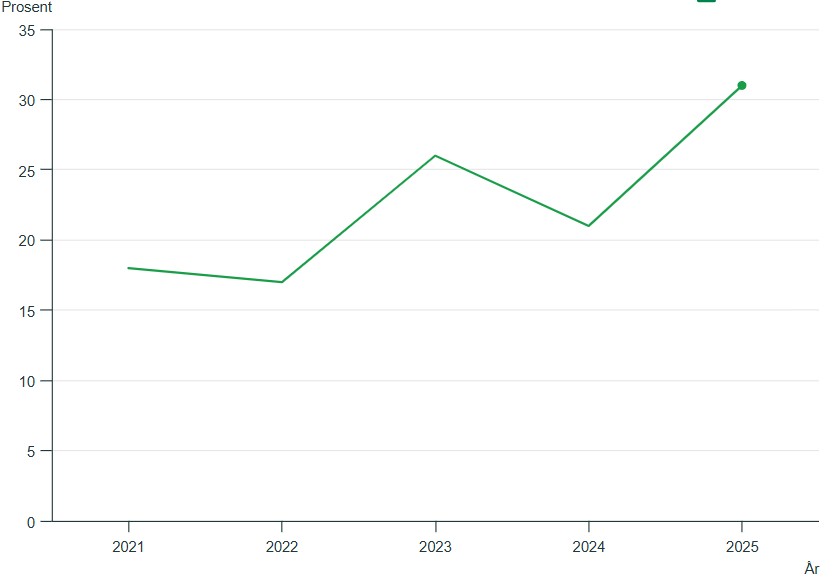
Percentage of people looking for a new job among employed graduates in Norway (aged 20-34).Ill. SSB
There are jobs in Norway, but not always your dream job
Among graduates with a bachelor's, master's, or doctoral degree, the group of people looking for another job is growing. After an increase in 2022–2023 and a decrease the following year, in 2025 the percentage rose again significantly. The trend is upward. At the same time, SSB does not record an increase in partial unemployment.
Partially unemployed are people working part-time who are willing to work more and have tried to increase their working hours. According to Tonje Køber, the data suggests that the search for a new job is not primarily due to the need for more hours. The reason may be the desire to move to a position with different employment conditions or different responsibilities.
Partially unemployed are people working part-time who are willing to work more and have tried to increase their working hours. According to Tonje Køber, the data suggests that the search for a new job is not primarily due to the need for more hours. The reason may be the desire to move to a position with different employment conditions or different responsibilities.
The data also shows a decrease in the share of university graduates working in academic and similar professions. This does not provide a full assessment of the match between work and education, but it signals the direction of change. More and more young people with a diploma are working, but not always in jobs corresponding to their level of education.
How do you rate this article?