Sales of new homes in Norway fell by 24%. What does this mean for the construction industry?
The Norwegian new-home market has recorded its weakest August since monthly measurements began in 2010. Data published on 16 September show that sales fell by almost a quarter year on year. For people working in house and apartment construction, this signals a risk of fewer future contracts, although it does not mean that there is already the same proportion of less work.
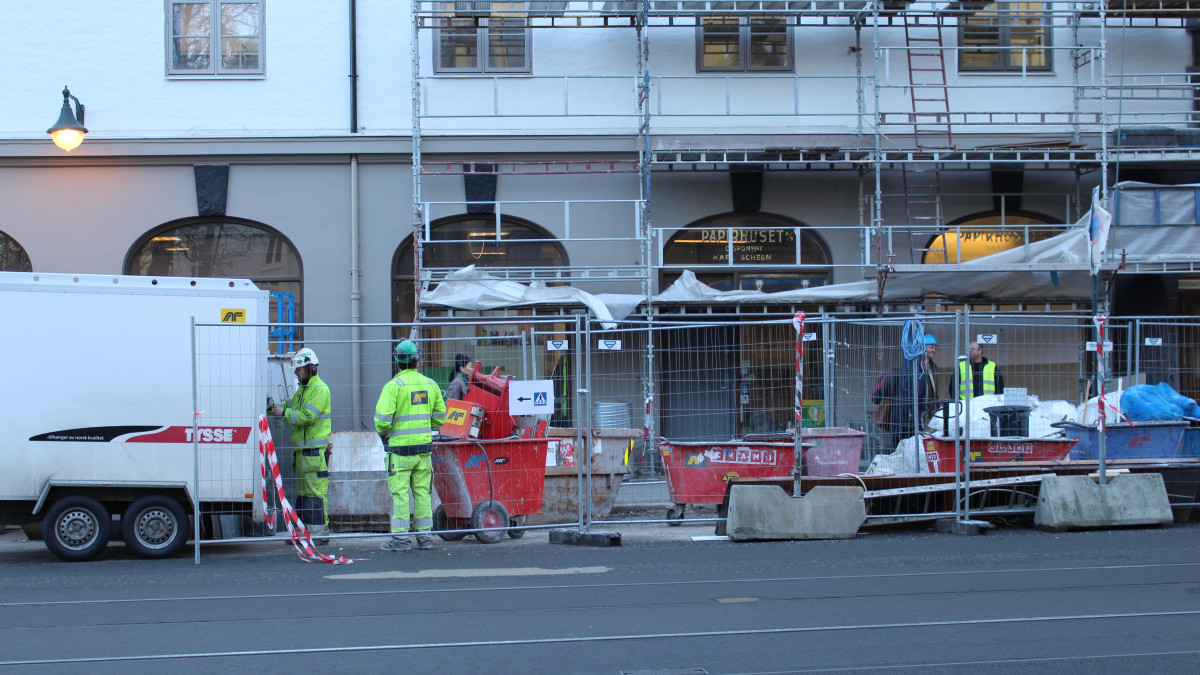
Polish construction workers
Adam Łukasik/Multinor
In brief
- Sales of new apartments and houses fell by 24% year on year in August.
- From January to August, 8,534 units were sold, 18% fewer than a year earlier.
- Construction started on 8,289 units, 1% more than a year earlier.
- The fall in sales does not automatically mean an equally large decline in work or employment in construction.
- If there is a temporary lack of contracts, an employer may consider permittering, while the employee still has specific rights.
Boligprodusentenes Forening, an organisation representing the residential construction industry, points to the relationship between today’s sales and investments carried out in subsequent years. A weaker inflow of new orders may only be felt after the work that companies already have under contract has been completed.
8,534 new houses and apartments sold since the beginning of the year
From January to August 2026, sales amounted to 8,534 residential units, 18% less than in the same period of 2025. In August alone, the decline reached 24%.
The statistics cover both houses and apartments. They do not concern transactions on the secondary market. The results for individual segments are as follows:
| Type of property | Sales from January to August 2026 | Year-on-year change |
|---|---|---|
| Detached houses | 2,009 | -12% |
| Terraced houses and other small-house developments | 1,987 | -15% |
| Apartments in multi-unit buildings | 4,538 | -21% |
The largest percentage decline in this comparison concerns apartments in multi-unit buildings.
Slightly more homes have been started than a year ago
Data on construction starts do not show as large a decline as sales. From January to August, construction began on 8,289 houses and apartments, 1% more than a year earlier. In August alone, however, a 3% decline was recorded.
This concerns the number of units covered by construction starts, referred to as igangsetting. It is not the number of construction sites or completed homes.
Sales results and construction starts are not contradictory. A developer may be building homes sold earlier while at the same time having fewer buyers for its next project. Therefore, the full schedule of current construction does not yet determine the number of contracts after it is completed.
A 24% fall in sales does not mean 24% less work
A separate picture of the whole industry is provided by Statistics Norway (SSB). According to the latest available data, concerning July 2026, activity in construction was 2.2% lower than a year earlier, after adjusting for differences in the working calendar.
This indicator is calculated on the basis of hours worked. It covers building construction, civil engineering works and specialised construction activities. It therefore has a different scope than sales of new homes.
Sales data cannot be used to calculate the number of future layoffs or to conclude that all companies are losing contracts at the same pace. Nor do they provide grounds for claiming that employment in construction has decreased by one quarter. They describe a specific part of the market, not the situation of every contractor.
SSB does not expect a rapid recovery
The problem is not limited to one weak month. In a forecast published on 15 September, SSB recalls that residential investment fell by a total of around 25% in 2023–2024. Since then, it has remained at a low level.
The agency points to three barriers: weak sales of new homes, high construction costs and still high interest rates on loans. According to this forecast, residential investment will remain roughly unchanged in both 2026 and 2027.
SSB also forecasts one further increase in the key interest rate by 0.25 percentage points in autumn 2026. This is the agency’s forecast, not an announced decision by Norges Bank. However, it gives no reason to assume that a rapid fall in financing costs will solve the industry’s problems as early as this autumn.
Weak sales do not mean there are too many homes
Prognosesenteret estimates the annual need at 28,194 new residential units. Meanwhile, construction began on 15,610 units covered by industry statistics in the 12 months to the end of August.
However, these figures have different scopes. The estimate of needs also includes student housing and assisted-living housing, which were not included in the data on new developments. Therefore, one value should not be subtracted from the other and the result presented as the exact number of missing homes.
Weaker sales are also not, in themselves, proof that buyers can expect price reductions. With high construction and loan costs, the need to own a home does not necessarily translate into the ability to buy one.
What to check at your company before winter
For a carpenter, bricklayer, installer or finishing-crew worker, it will be more useful than national statistics alone to establish what work the company already has confirmed. When speaking with the employer, it is worth asking:
- How long will work from signed contracts last?
- Which upcoming projects have a confirmed start date, and which are still only planned?
- How does the company intend to organise work if there is a gap between construction projects?
A similar review will be useful for the owner of a small subcontracting company. When planning employment and expenses, it is better to separate signed orders from requests for quotations. When calculating the next contract, the possibility that the start date on site will be postponed should also be taken into account, rather than assuming uninterrupted work based on verbal assurances.
This is a way of assessing the situation of a specific company, not a forecast that every crew will face downtime.
Lack of contracts and permittering. Employees still have rights
If the lack of work is temporary, the employer may consider permittering, i.e. temporary release from the obligation to work. It is not termination of the contract: the employment relationship continues. It may cover full-time work or part of it and must be justified by the company’s situation.
Arbeidstilsynet lists a lack of orders as one possible reason. However, it stresses that the difficulties must be temporary. If it is known or highly likely that the lack of work will be permanent, termination rules should be applied rather than replacing them with permittering.
As a rule, an employee should receive written notice 14 days in advance. During the notice period, they retain their normal pay. Once permittering begins, an initial period of salary payment by the employer also applies. Details may depend on the circumstances and the applicable collective agreement.
Unemployment benefit, known as dagpenger, is not granted automatically. You must meet NAV’s conditions, register as a jobseeker and submit an application. Every 14 days, you must send in meldekort reporting cards, including while waiting for a decision. People living in Poland and commuting to Norway should also check the rules connected with their country of residence.
For the NAV application, documentation of employment and permittering is required (translation quote in 3 minutes, PL/NO). The notice from the employer should include, among other things, the reason for the break, its start date and information on the extent to which the employee is covered by permittering.
Bibliography
- Boligprodusentenes Forening, Historically weak new-home sales ahead of the state budget, 16 September 2026.
- Prognosesenteret, Status of sales and construction starts for new homes – August 2026, 16 September 2026.
- SSB, Production index for construction activity, updated 26 August 2026, data for July 2026.
- SSB, Increased purchasing power despite high interest rates, 15 September 2026.
- Arbeidstilsynet, Permittering, accessed 16 September 2026.
- NAV, Dagpenger, accessed 16 September 2026.
- Finansavisen, Boligprodusentene: Historically weak new-home sales ahead of the state budget, 16 September 2026.
How do you rate this article?