Is Norway’s healthcare system dependent on immigrants? The numbers are telling an increasingly clear story
One in five people employed in Norway’s healthcare sector is an immigrant. Over the past decade, the number of workers of foreign origin has increased significantly, and in some professions they account for almost all employment growth. The latest data show how important a role immigrants play in a system that is already struggling with staff shortages.
Norway’s healthcare system would not cope without immigrants.
Fot. Adobe Stock, licencja standardowa (zdjęcie poglądowe)
In 2025, nearly 88,000 immigrants worked in Norway’s health and care sector, including people commuting to work from abroad. This was 32,000 more than in 2015. According to data from Statistics Norway (SSB), their share of employment rose from 14.4 to 19.5 percent during this period. At the same time, demand for healthcare and care staff increased.
Immigrants are driving employment growth. Without them, the number of workers could fall
The biggest changes concern healthcare assistants. In 2025, immigrants accounted for 27.3 percent of this occupational group, or 23,850 out of 87,340 employees. Over ten years, their share increased by 11.8 percentage points. The total number of care workers rose by only 2 percent during this period. SSB estimates that if the number of immigrants working in this profession had remained at the 2015 level, employment in this group would have fallen by 10.4 percent.
Immigrants also play an important role among doctors and nurses. In 2025, they accounted for 23.2 percent of doctors and 15.3 percent of nurses, including specialist nurses. For the latter group, the share of immigrants increased by 2.8 percentage points over the decade. SSB indicates that one possible reason for slower growth is stricter requirements for recognising foreign nursing qualifications.
Immigrants also play an important role among doctors and nurses. In 2025, they accounted for 23.2 percent of doctors and 15.3 percent of nurses, including specialist nurses. For the latter group, the share of immigrants increased by 2.8 percentage points over the decade. SSB indicates that one possible reason for slower growth is stricter requirements for recognising foreign nursing qualifications.
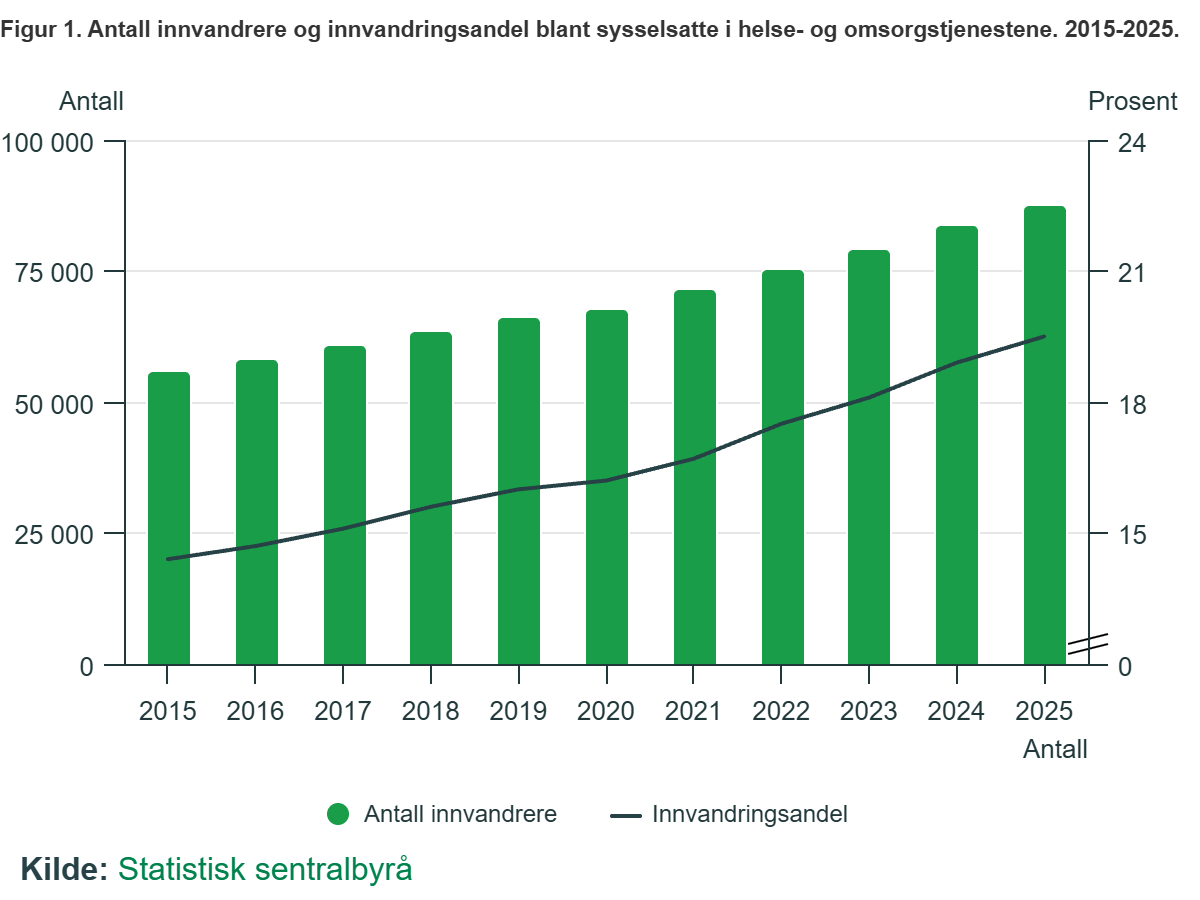
Number of immigrants and the share of immigrants among people employed in healthcare and social care.Fig. SSB
Thousands of workers are missing. Demand will continue to grow
Staff shortages are already evident. According to a survey by the Norwegian Labour and Welfare Administration (NAV), there was a shortage of around 3,650 healthcare assistants and 2,200 nurses in 2026. The estimated shortage of doctors amounted to a further 650 people. Forecasts point to a further worsening of the problem. By 2040, the shortfall in 14 selected healthcare-related occupational groups could amount to around 42,400 full-time positions.
However, the growing role of workers from abroad is linked to specific challenges. SSB forecasts assume that immigration will remain at its current level, and any reduction could further increase staff shortages. Meanwhile, other countries are also facing ageing populations and rising demand for medical workers. The Norwegian Health Personnel Commission has drawn attention to the risks associated with extensive use of foreign staff, pointing, among other things, to the need to learn the language and the possibility that workers may move to other countries.
However, the growing role of workers from abroad is linked to specific challenges. SSB forecasts assume that immigration will remain at its current level, and any reduction could further increase staff shortages. Meanwhile, other countries are also facing ageing populations and rising demand for medical workers. The Norwegian Health Personnel Commission has drawn attention to the risks associated with extensive use of foreign staff, pointing, among other things, to the need to learn the language and the possibility that workers may move to other countries.
The employment structure is also important. Nearly 90 percent of the increase in the number of immigrants working in the health and care sector since 2015 has been in positions requiring direct contact with patients. At the same time, 31 percent of employed immigrants had lived in Norway for more than 20 years, showing that a significant proportion of this group has long been connected to the Norwegian labour market.
How do you rate this article?