26.11.2026 14:49
144,000 people were looking for work in Norway. Who does SSB count as unemployed?
In October, 144,000 people in Norway were out of work, or 4.7% of the labour force. The figure comes from the Labour Force Survey by Statistics Norway (SSB). At the same time, NAV had 59,100 people registered as fully unemployed, almost half of them immigrants.

Safety helmet and work gloves
Kindel Media / Pexels
Unemployment up 0.1 percentage points from September
The figures come from the Labour Force Survey (AKU), which SSB published on 25 November. Unemployment rose by 0.1 percentage points in a month. SSB still describes it as stable over the past year: since the turn of the year it has been at 4.6–4.7%.
The key figures for October:
SSB publishes so-called trend figures, with seasonal and random variation removed. The agency notes that figures for the most recent months are the least certain, because the trend calculation is partly based on projected values. They may therefore be revised.
The key figures for October:
- 144,000 – unemployed people aged 15–74,
- 4.7% – their share of the labour force,
- +0.1 percentage points – change from September.
SSB publishes so-called trend figures, with seasonal and random variation removed. The agency notes that figures for the most recent months are the least certain, because the trend calculation is partly based on projected values. They may therefore be revised.
Since the turn of the year, unemployment has been at 4.6–4.7 per cent, but the trend has moved in different directions for women and men.
Up for women, down for men
Among women, unemployment has risen from 4.1% to 4.5% since the turn of the year. Among men, it has fallen from 5.1% to 4.8%. Men are still more often out of work than women, but the gap has narrowed from 1.0 to 0.3 percentage points.
More young people are also entering the labour market. In the 15–24 age group, 69.7% are working or looking for work, up from 67.3% a year earlier. Both employment and unemployment in this group have risen over the past year.
SSB says 144,000, NAV says 59,000. Why?
Norway gets two unemployment figures every month. NAV reported that 59,100 people were registered as fully unemployed in October, or 2.0% of the labour force. That is less than half of the 144,000 in SSB's survey.
Both use the same three criteria: you have no paid work, you are looking for work and you are available to start. What differs is how people are counted:
According to SSB, young people and others with no right to unemployment benefit are less likely to register with NAV. People on NAV's labour market programmes are not counted as fully unemployed in the register, but may be unemployed in SSB's survey. On the other hand, some people in NAV's register tell SSB's interviewers that they are not looking for work, or that they have a job.
SSB has described the result itself: only one in six of those who are unemployed in at least one of the sources is classified as unemployed in both.
Temporary layoffs (permittering) are also counted differently. NAV includes laid-off workers from the first day, while SSB counts them only once the layoff has lasted more than three months without a break.
Both use the same three criteria: you have no paid work, you are looking for work and you are available to start. What differs is how people are counted:
- NAV counts people registered with the agency. It is a full count from the register, but anyone who only looks for work on their own is not in it.
- SSB interviews a sample of the population. You count as unemployed if you have no paid work, have looked for work in the past four weeks and can start within two weeks. Whether you are registered with NAV does not matter.
According to SSB, young people and others with no right to unemployment benefit are less likely to register with NAV. People on NAV's labour market programmes are not counted as fully unemployed in the register, but may be unemployed in SSB's survey. On the other hand, some people in NAV's register tell SSB's interviewers that they are not looking for work, or that they have a job.
SSB has described the result itself: only one in six of those who are unemployed in at least one of the sources is classified as unemployed in both.
Temporary layoffs (permittering) are also counted differently. NAV includes laid-off workers from the first day, while SSB counts them only once the layoff has lasted more than three months without a break.
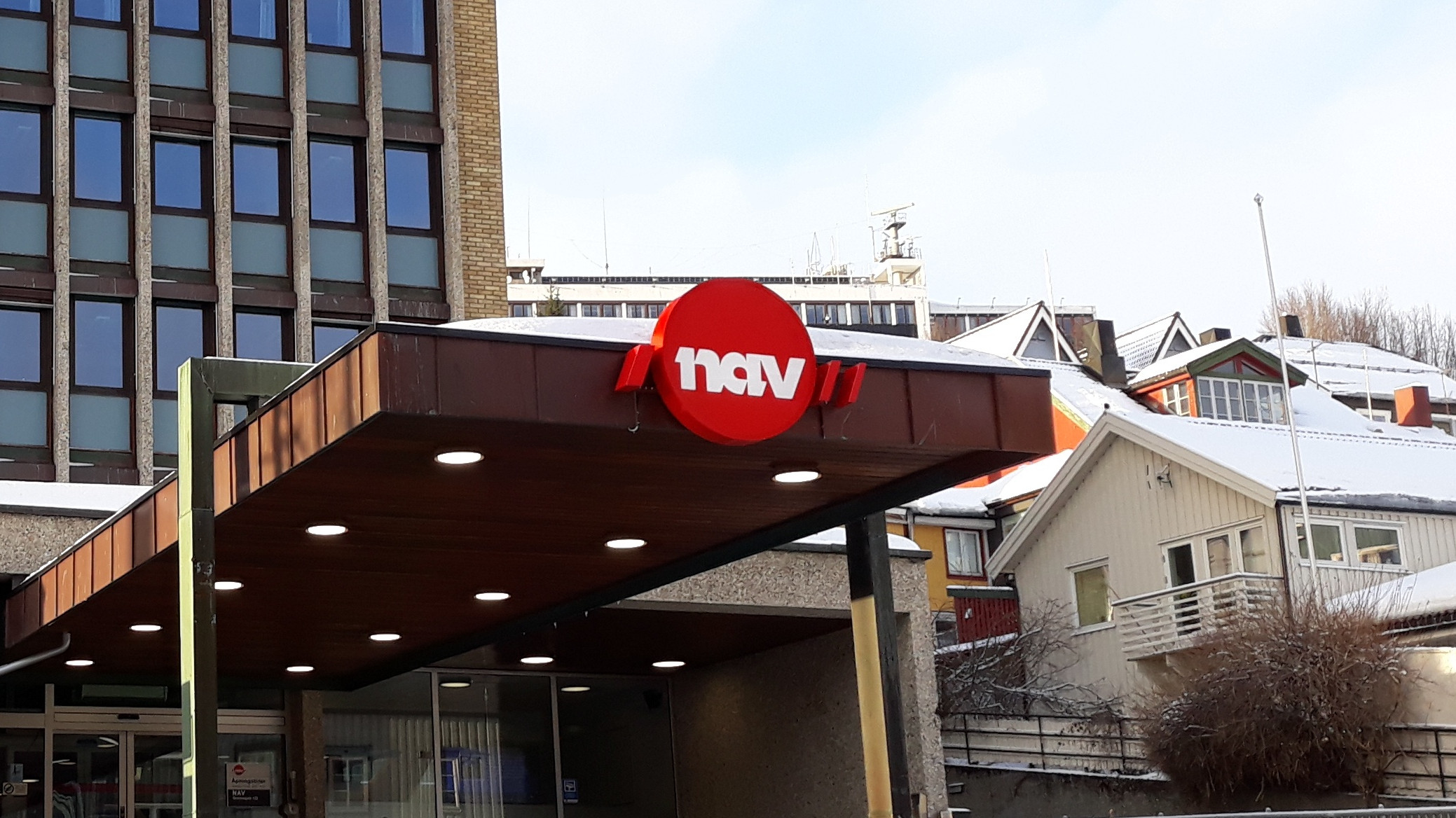
You only get unemployment benefit after registering with NAV. Pictured: the entrance to a NAV office.Photo: MN
Immigrants are almost half of NAV's register
NAV also publishes the number of registered unemployed by country of birth. In October, 28,104 of the 59,142 people registered as fully unemployed were immigrants. The largest groups were born in Ukraine (4,053), Poland (3,261), Syria (1,961), Somalia (1,370) and Lithuania (1,288).
In January the register had 33,711 immigrants, in September 28,094. The figures are not seasonally adjusted, so January and October cannot be compared directly.
Registered unemployment is 4.6% among immigrants and 1.3% in the rest of the population. For immigrants from Europe it is 4.3%, from Asia 4.6% and from Africa 6.1%. NAV does not publish a rate for individual countries.
In the October press release, NAV director Hege Nilssen pointed to construction, where unemployment has fallen the most. “The decline is probably because some labour immigrants have returned to their home countries, and not because of higher activity in the industry,” she said.
Losing your job? Benefit only comes through NAV
You can be counted in SSB's survey without contacting anyone. You only get unemployment benefit (dagpenger), however, if you register with NAV as a job seeker and apply. According to NAV, you may be entitled when:
The benefit is 62.4% of your previous income; income above NOK 819,294 a year is not counted. NAV pays it for up to 104 weeks, or up to 52 weeks if your income was below NOK 273,098. If you also worked in another EEA country in the past 36 months, NAV needs a PD U1 certificate from that country.
- you have lost at least 50% of your working hours and all or part of your income,
- you have earned at least NOK 204,824 in the past 12 months or NOK 409,647 in total over the past 36 months,
- you are under 67,
- you are staying in Norway and are a member of the National Insurance Scheme (folketrygden),
- you send an employment status form (meldekort) every 14 days and are genuinely looking for work.
The benefit is 62.4% of your previous income; income above NOK 819,294 a year is not counted. NAV pays it for up to 104 weeks, or up to 52 weeks if your income was below NOK 273,098. If you also worked in another EEA country in the past 36 months, NAV needs a PD U1 certificate from that country.
Do not wait with the application. NAV recommends applying two weeks before the last day you are entitled to pay. You can get unemployment benefit at the earliest from the day you send the application and register as a job seeker.
Job growth comes mainly from immigrants
SSB also published figures on jobs (one person can hold several). From September 2025 to September 2026 the number rose by almost 29,500. Nearly 19,000 of these, more than 60%, were among immigrants. According to SSB, immigrants have accounted for the largest share of job growth every month since 2023. The biggest increase, 7,700, was among immigrants from Ukraine.
Preliminary figures for October show a fall of just over 6,000 from September, or 0.2%. The decline was mainly in health and social services (3,100) and education (2,600). SSB notes that preliminary figures are less certain than final ones.
Where to check the figures
The survey figures are in SSB's article of 25 November. SSB explains the differences between the two statistics in a separate article. The register figures are in NAV's press release of 30 October and in NAV's tables, including by country of birth. NAV describes the benefit rules in English at nav.no/dagpenger/en. The other pages are in Norwegian.
This text was prepared using AI, based on the sources listed in the article.
How do you rate this article?
Latest articles
-
 47% of Poles in Norway believe their Norwegian is good enough. Nearly half paid for a course themselves
-
 Starting Monday, an SMS from the state about church membership. It is not a scam; the message contains no link
-
 Vestfold Line: from Sunday, only three evening trains in each direction. Full line to reopen on 7 December
-
 Morning briefing: 3 out of 4 products became cheaper after Black Friday, a text message from the government, thaw this weekend
-
 Electricity averages NOK 3.89 on Thursday, the highest this year. Record-low reservoir levels in the south
-
 Christmas ribs for NOK 59 per kilogram. Extra, Kiwi and Rema 1000 cut prices by more than half