Poles Still Number One in Norway. Latest Data Shows What Is Happening in the Labour Market
Poles remain the largest group of foreign workers in Norway. This applies both to people living in the country and to those who commute to work without formal registration. At the same time, the number of workers from Poland has declined slightly in recent years.

The construction industry in Norway employs a significant proportion of labour immigrants.
Fot. Fotolia
Nearly one in ten people working in Norway is a labour immigrant or a foreign worker commuting to the country. This is according to data from Statistics Norway (SSB) published on 4 September 2026. SSB indicates that the number of employed labour immigrants continued to grow after the pandemic, although a decline among foreign commuting workers has been visible since 2022. Poles remain an important part of the market, being the most common country of origin in both groups.
Poles Still in First Place, but the Number of Workers Has Declined
Poland remains the most common country of origin among labour immigrants living in Norway. The situation is the same among people who work in Norway but are not formally registered as residents there. Lithuania ranks second. Among settled labour immigrants, Germany takes third place.
After 2022, the number of labour workers from Poland and Lithuania declined slightly. At the same time, the group of people from the new European Union member states admitted after 2004 continues to clearly dominate labour migration to Norway. In 2021, it accounted for 63 per cent of all such workers, compared with 59 per cent in 2025. During the same period, the number of people arriving from, among other countries, India, Spain, Latvia and Romania increased.
After 2022, the number of labour workers from Poland and Lithuania declined slightly. At the same time, the group of people from the new European Union member states admitted after 2004 continues to clearly dominate labour migration to Norway. In 2021, it accounted for 63 per cent of all such workers, compared with 59 per cent in 2025. During the same period, the number of people arriving from, among other countries, India, Spain, Latvia and Romania increased.
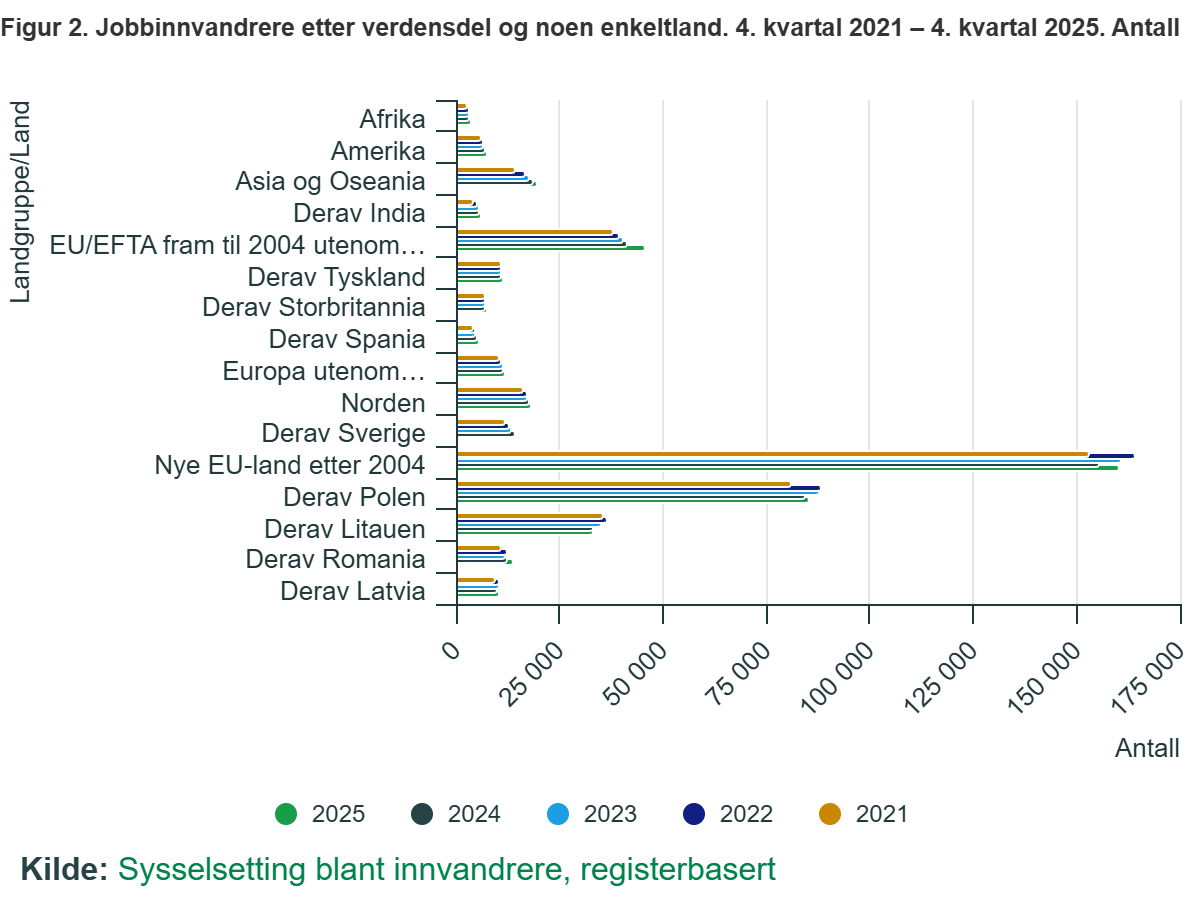
Labour immigrants by continent and individual country. Fourth quarter of 2021 – fourth quarter of 2025.Fig. SSB
Construction Continues to Attract Workers. The Market Has Undergone Changes
The largest number of foreign labour workers find employment in construction. Their share is also very high in business services, including companies involved in hiring out workers. In this group, they account for 26 per cent of all employees. SSB assumes that many workers employed by agencies are then assigned to the construction sector.
After 2020, however, the employment structure began to change. Between 2022 and 2024, the number of labour workers in the employment agency and worker-hiring sector fell by 19 per cent, which SSB links, among other things, to changes in regulations governing the use of temporary labour. From 2023 to 2025, the number of such workers also decreased by 9 per cent in construction and in sectors related to energy, water and waste management. Growth, on the other hand, was recorded in healthcare and social services, hotels, restaurants and manufacturing.
After 2020, however, the employment structure began to change. Between 2022 and 2024, the number of labour workers in the employment agency and worker-hiring sector fell by 19 per cent, which SSB links, among other things, to changes in regulations governing the use of temporary labour. From 2023 to 2025, the number of such workers also decreased by 9 per cent in construction and in sectors related to energy, water and waste management. Growth, on the other hand, was recorded in healthcare and social services, hotels, restaurants and manufacturing.
For many Poles, the possibility of earning higher wages than in their country of origin remains an important reason for moving to Norway. However, studies cited by SSB also point to the importance of employment conditions, predictability at work and work-life balance. These factors, alongside pay, influence the decision to take up work in Norway.
How do you rate this article?