Fewer Immigrant Families Arriving in Norway. Poles Traditionally Among the Top Groups
Norwegian statistical data shows that for every hundred refugees who arrived in the country between 1990 and 2020, there was an average of 43 family members. Recent years have also seen a marked decrease in the number of people coming to Norway through family reunification. At the same time, the number of family arrivals to underage refugees continues to rise.
Family migration largely depends on the influx of refugees.
Fot. Pixabay
In 2024, 11,638 people arrived in Norway through family reunification. This is over 3,000 fewer than the previous year. Statisticians emphasize, however, that the actual number may be slightly higher, as the basis for residence was not recorded for 7 percent of immigrants.
Based on assumptions from 2017–2019, this amounts to an estimated 12,400 family migrations. This is a clear decrease compared to the projected 18,900 in 2022 and 15,200 in 2023.
Based on assumptions from 2017–2019, this amounts to an estimated 12,400 family migrations. This is a clear decrease compared to the projected 18,900 in 2022 and 15,200 in 2023.
Most Family Migrants from Syria and Poland
The largest group of family migrants in 2024 were Syrians, with 860 registered. Poles and Indian citizens followed, each group recording over 700 arrivals.
For Poles, a large percentage had an unknown reason for migration, which may affect the assessment of their share in the statistics. Among non-EU migrants, most family arrivals concerned citizens of Syria, India, Pakistan, the Philippines, and Afghanistan. The data also indicates a very limited number of family arrivals for Ukrainians, mainly due to their temporary collective protection status.
For Poles, a large percentage had an unknown reason for migration, which may affect the assessment of their share in the statistics. Among non-EU migrants, most family arrivals concerned citizens of Syria, India, Pakistan, the Philippines, and Afghanistan. The data also indicates a very limited number of family arrivals for Ukrainians, mainly due to their temporary collective protection status.
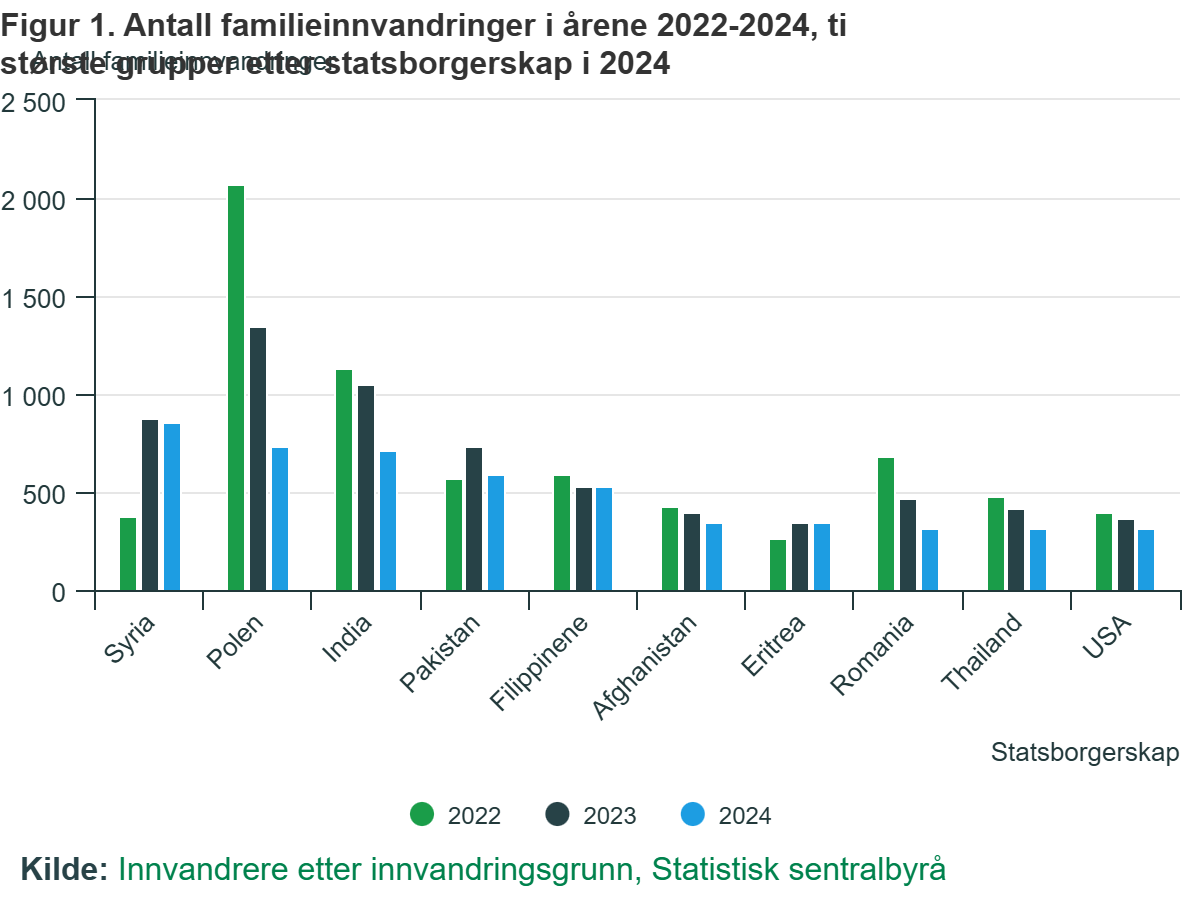
Number of family immigrations in 2022-2024, the ten largest groups by citizenship.Illustration: Norwegian Statistical Office
Differences Between National Groups
A long-term analysis covering 1990–2024 shows that out of 276,314 refugees, just over one-tenth received permission to bring close relatives. In total, 77,765 family members arrived, which gives a ratio of 0.28 per person.
More detailed calculations for the group of refugees from 1990–2020 raise the indicator to 0.43 when subsequent 'chain' migration stages are included. The highest rates of family migration are among refugees from Somalia, Iraq, and stateless persons. The lowest rates are among Bosniaks, Kosovars, and Russians.
More detailed calculations for the group of refugees from 1990–2020 raise the indicator to 0.43 when subsequent 'chain' migration stages are included. The highest rates of family migration are among refugees from Somalia, Iraq, and stateless persons. The lowest rates are among Bosniaks, Kosovars, and Russians.
More Family Arrivals to Underage Refugees
Clear differences are also seen in terms of the age and gender of refugees. The vast majority of family arrivals concern adult men, who often arrived first, with their families joining in subsequent years. The situation is different for those who arrived as unaccompanied minors—each of them had 0.52 family migrants, counting three levels of family reunification.
The increase mainly concerns Syrians, who have the right to family reunification, which is less often the case for, for example, Afghans. The data also shows that family gathering in these groups is dynamic, and bringing relatives usually begins quickly after obtaining protection.
The increase mainly concerns Syrians, who have the right to family reunification, which is less often the case for, for example, Afghans. The data also shows that family gathering in these groups is dynamic, and bringing relatives usually begins quickly after obtaining protection.
The latest statistics confirm that the process of family migration remains closely linked to protection rules, the structure of arrivals, and the specifics of individual refugee groups. Changes in the national composition of those arriving in Norway and regulations affecting the pace and scale of family reunification are also becoming increasingly important. In the coming years, these factors may determine further trends and directions in family migration.
How do you rate this article?