There were 1.4 million pairs, now there are 165,000. Iconic birds are disappearing from Lofoten
On Røst in Lofoten, scientists counted around 165,000 breeding pairs of puffins this season. A year earlier, there were more than 200,000, while in 1979 there were around 1.4 million. Researchers point out that one of the birds' most serious problems is increasingly difficult access to food.

Lofoten is becoming increasingly vulnerable to climate change.
Fot. Adobe Stock, licencja standardowa
The number of puffins on Røst is clearly declining. Over the course of a year, the number of breeding pairs fell by around one fifth, and compared with 1979, the decline is nearly 90 percent. The character of the colony itself has also changed. Ornithologist Tycho Anker-Nilssen from the Norwegian Institute for Nature Research (NINA), who has been conducting observations on Røst since 1981, noted that the islands once ranked among the richest concentrations of seabirds in northern Europe.
A shortage of young herring. Puffins are searching farther afield
NINA points to a food shortage. Puffins from Røst are particularly dependent on young herring, which ocean currents carry north along the Norwegian coast. Until now, the fish appeared in the Lofoten area when the birds needed large amounts of food for their chicks. This mechanism is becoming disrupted more and more often.
The Norwegian spring-spawning herring stock collapsed in the late 1960s. The Norwegian Institute of Marine Research concluded that overfishing was the main cause, although unfavourable natural conditions also played a role. According to specialists, herring numbers would probably have declined even without fishing. However, the collapse would not have been as severe.
The Norwegian spring-spawning herring stock collapsed in the late 1960s. The Norwegian Institute of Marine Research concluded that overfishing was the main cause, although unfavourable natural conditions also played a role. According to specialists, herring numbers would probably have declined even without fishing. However, the collapse would not have been as severe.
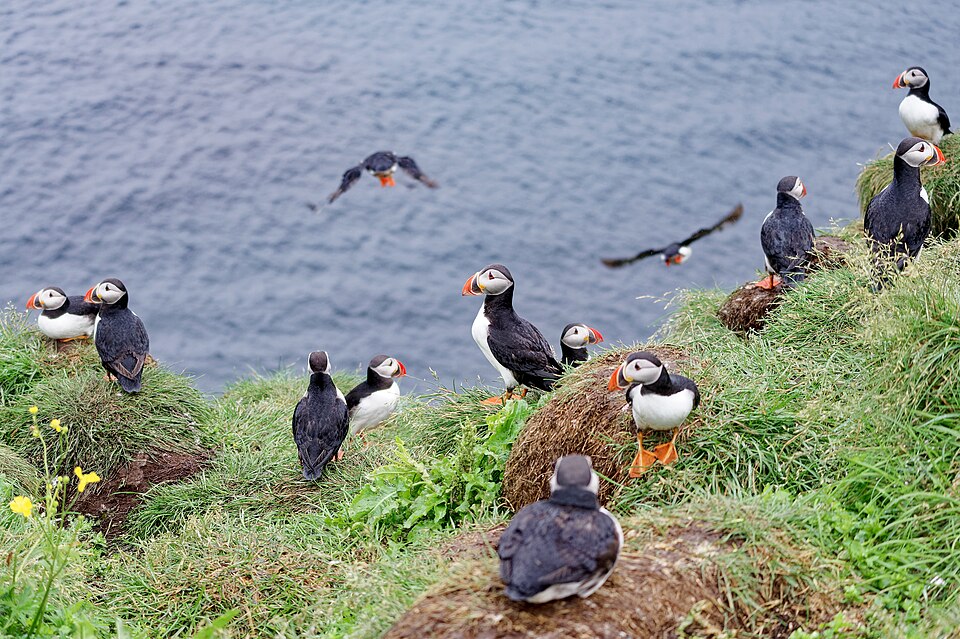
A warmer ocean is changing Lofoten. Puffins have less and less food.Photo: Jakub Hałun, CC BY 4.0, via Wikimedia Commons
The ocean is warmer. Mackerel are reaching farther north
The changes also concern water temperature. A warmer ocean has opened up new feeding grounds around Lofoten for mackerel, which previously did not occur there on such a scale. These fish eat herring larvae and fry, as well as the plankton they feed on. The magazine „Forskning” noted that the arrival of mackerel is a new factor linked to increasingly warmer ocean waters.
Warmer water may also alter the timing of herring spawning. Their larvae may move north earlier, before puffins begin their period of intensive feeding of their young. When suitable food is scarce near the colony, the birds must make longer trips. GPS tracking studies showed that in colonies with low breeding success, puffins travelled more than 100 km in search of fish. They then brought less food to their nests, and the fish were of poorer quality.
Warmer water may also alter the timing of herring spawning. Their larvae may move north earlier, before puffins begin their period of intensive feeding of their young. When suitable food is scarce near the colony, the birds must make longer trips. GPS tracking studies showed that in colonies with low breeding success, puffins travelled more than 100 km in search of fish. They then brought less food to their nests, and the fish were of poorer quality.
The effects can also be seen in the development of young birds. With smaller food supplies, chicks grow more slowly, and some of them die of starvation. As a result, the colony on Røst, which Tycho Anker-Nilssen has observed for more than four decades, is changing.
How do you rate this article?