Strait of Hormuz, oil and gas. Country's income increased, residents' purchasing power fell?
The war in the Middle East has affected Norway's income. Bruttonasjonalinntekten, or gross national income, rose by 4.4 percent in the first quarter of 2026. Statistics Norway (SSB) points to very high revenues from oil and gas extraction.

High budget revenues did not translate into increased wealth for Norway's residents.
Zdjęcie poglądowe/Fot. Jernej Furman (Flickr.com, CC BY 2.0)
The increase was strongly linked to March. That was when the war in Iran and the closure of the Strait of Hormuz caused a shock in the oil market. Commodity prices soared. SSB reports that higher oil and gas prices increased the value of gross domestic product at current prices by 6.2 percent.
Gross national income rose by NOK 62 billion. The data are adjusted for seasonal and calendar fluctuations. Norway's disposable income also increased. It was 5.0 percent higher than in the fourth quarter of 2025.
Gross national income rose by NOK 62 billion. The data are adjusted for seasonal and calendar fluctuations. Norway's disposable income also increased. It was 5.0 percent higher than in the fourth quarter of 2025.
Oil boosted revenues. The state increased its surplus
The biggest boost came from the oil and gas sector. Prices rose after the outbreak of war in Iran. SSB also points to the closure of the Strait of Hormuz. These factors translated into higher extraction revenues.
A large part of such income goes to the state. This is due to the petroleum tax system and the State's Direct Financial Interest (SDØE). The surplus in the government and local government sector increased by NOK 61 billion. It reached NOK 149 billion, which was 68.8 percent higher than the previous quarter.
A large part of such income goes to the state. This is due to the petroleum tax system and the State's Direct Financial Interest (SDØE). The surplus in the government and local government sector increased by NOK 61 billion. It reached NOK 149 billion, which was 68.8 percent higher than the previous quarter.
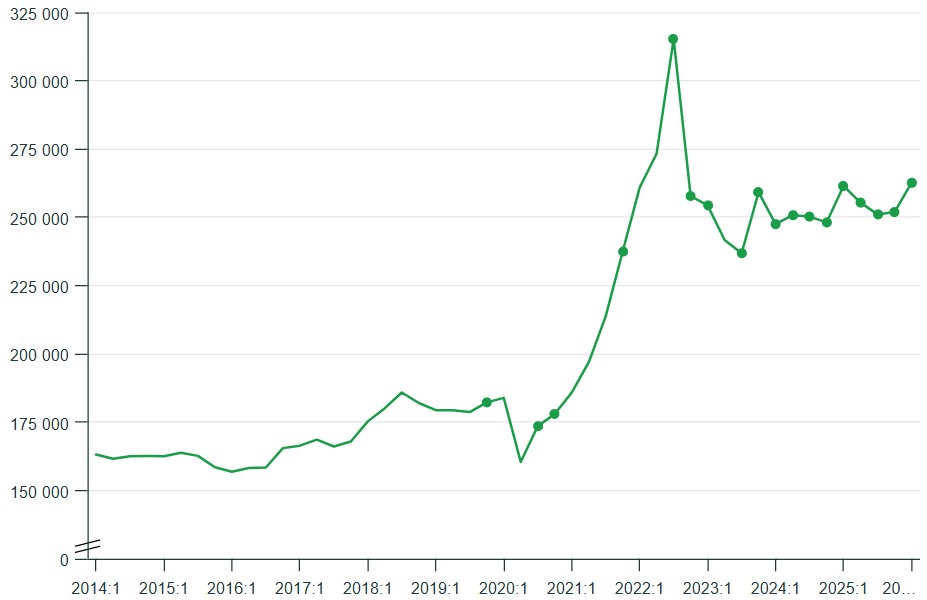
Gross national income per capita in Norway, seasonally adjusted.Ill. SSB
Norwegian residents felt the pressure. Consumption slightly declined
The situation for households looked different. Their disposable income increased by 0.6 percent. This is less than the rise in prices. Real disposable income, which reflects purchasing power, fell.
Wages increased by 1.7 percent, adding about NOK 10 billion. However, income from assets slowed the growth rate. Excluding dividends, the purchasing power of households was almost unchanged, rising by just 0.1 percent.
Consumption fell by 0.1 percent. This is the first such situation since the first quarter of 2023. SSB links this to fluctuations in car purchases. After high car sales in the fourth quarter of 2025, purchases in the first quarter of 2026 were unusually low.
Wages increased by 1.7 percent, adding about NOK 10 billion. However, income from assets slowed the growth rate. Excluding dividends, the purchasing power of households was almost unchanged, rising by just 0.1 percent.
Consumption fell by 0.1 percent. This is the first such situation since the first quarter of 2023. SSB links this to fluctuations in car purchases. After high car sales in the fourth quarter of 2025, purchases in the first quarter of 2026 were unusually low.
SSB has also revised previous data for 2025. Gross national income was reduced by nearly NOK 5 billion. The office notes that quarters after 2023 are still preliminary data and remain more uncertain.
How do you rate this article?