Norwegians Enter the AI Era: The Gap Between Youth and Seniors
Norwegians are quickly integrating generative artificial intelligence (AI) into their daily lives. More than half of residents aged 16 to 79 already use tools like ChatGPT. However, the latest data from the Central Bureau of Statistics (SBB) reveals significant differences between various age groups and genders.

Only a small percentage of respondents do not know how AI tools work.
Fot. Adobe Stock, licencja standardowa
In 2025, 54 percent of respondents used generative AI. Among men, the rate was 58 percent, while among women it was 49 percent. The highest activity was recorded in the 16–24 age group, where 80 percent used AI.
The lowest usage was among those aged 75 to 79—only 6 percent used such tools. The youngest group was an exception, with women surpassing men: 84 percent of women and 76 percent of men used AI.
The lowest usage was among those aged 75 to 79—only 6 percent used such tools. The youngest group was an exception, with women surpassing men: 84 percent of women and 76 percent of men used AI.
What Stops Norwegians from Using AI?
Those who chose not to use AI most often cited a lack of need. In the 16–24 age group, 63 percent of respondents gave this reason. Among younger age groups, concerns about privacy and security were also common.
Few respondents declared a lack of knowledge about how the tools work or were unaware of their existence. In every age category, a small percentage also indicated other reasons for opting out.
Few respondents declared a lack of knowledge about how the tools work or were unaware of their existence. In every age category, a small percentage also indicated other reasons for opting out.
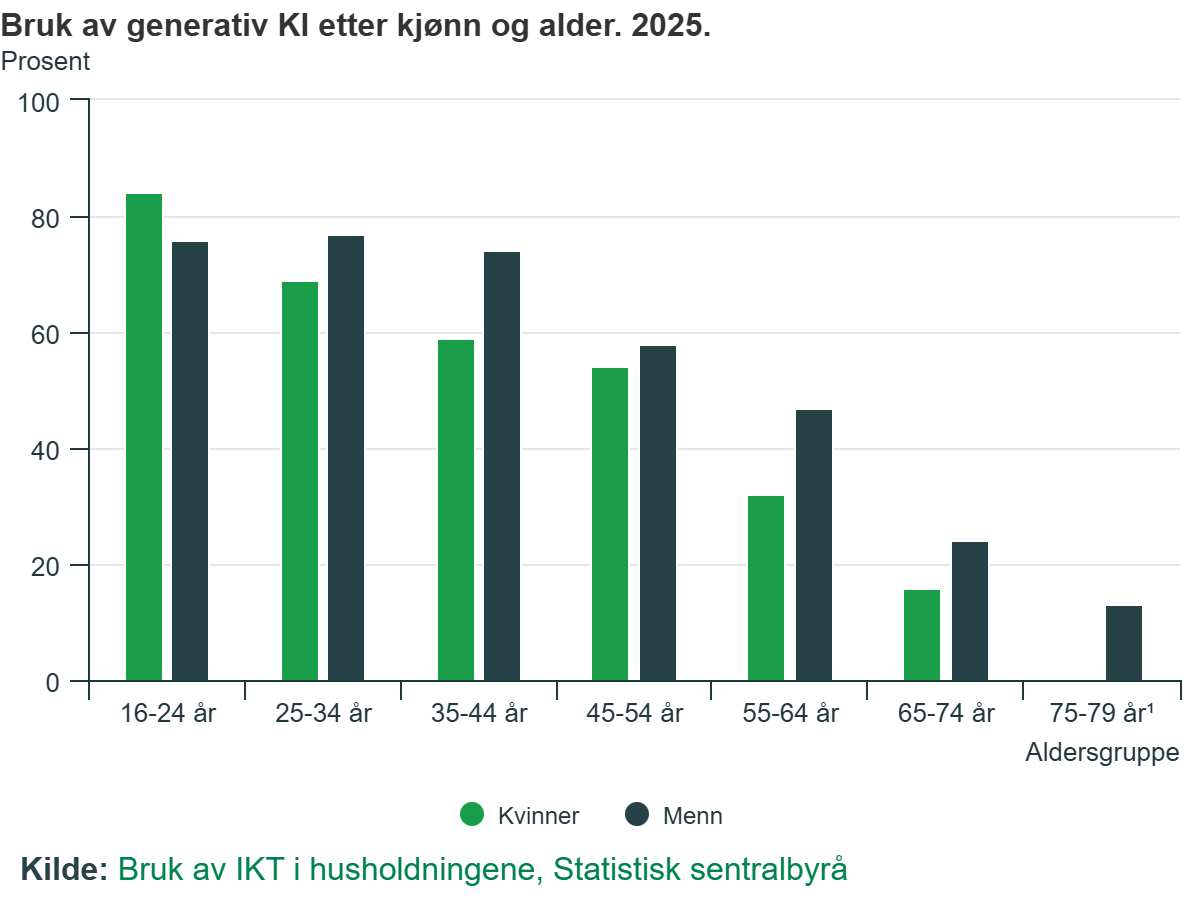
Use of generative artificial intelligence by gender and age.Ill. SBB
AI in Work, Education, and Business
Generative AI is most often used privately—84 percent of users said so. 63 percent of respondents use AI at work, and the youngest respondents eagerly use it in education; in the 16–24 age group, 69 percent do so.
In companies, text-based tasks dominate, primarily content analysis as well as text and speech generation. The highest level of AI usage was recorded in the information and communication sector, which includes media, film production, and programming activities. According to the data, these industries account for a significant share of business use of the technology.
In companies, text-based tasks dominate, primarily content analysis as well as text and speech generation. The highest level of AI usage was recorded in the information and communication sector, which includes media, film production, and programming activities. According to the data, these industries account for a significant share of business use of the technology.

Privacy concerns are most common among people under the age of 44.Photo: pxhere.com / CC0 Public Domain
AI in Public Administration Strategies
The use of AI in government strategies is increasing. In 2024, 53 percent of state institutions included AI in their plans, compared to 38 percent the previous year. In municipalities and regions, the levels were lower—29 percent and 32 percent, respectively.
At the same time, 73 percent of municipalities reported higher-than-expected costs for information and communication technologies, and 84 percent had difficulty allocating resources for digital service development. The data points to financial challenges that affect the pace of AI implementation at the local level.
At the same time, 73 percent of municipalities reported higher-than-expected costs for information and communication technologies, and 84 percent had difficulty allocating resources for digital service development. The data points to financial challenges that affect the pace of AI implementation at the local level.
The growing use of AI shows how Norwegian society and institutions are gradually incorporating this technology into their processes. Different levels of adoption among age groups and sectors create a complex picture of changes that are just gaining momentum. In the coming years, these trends may influence how AI is developed and integrated into many areas of public and private life.
How do you rate this article?