Norway Sets Record for Electricity Production and Exports, Helped by Warm 2025
In 2025, Norway produced more electricity than ever before. At the same time, household electricity consumption slightly decreased.

In the photo: a hydroelectric power plant near Lysebotn (archival photo).
Fot. denisbin, Flickr.com (CC BY-ND 2.0)
Total electricity production in 2025 reached 161.8 TWh. This is an increase of 3.0 percent compared to 2024, which was also a record year. The data comes from the latest statistics from Statistics Norway (SSB).
Production Record Thanks to Hydropower
Hydropower contributed the most to the increase in production. In 2025, hydropower plants generated 145.5 TWh of electricity, which is 3.9 percent more than the previous year. The high level of production was linked to large amounts of water in reservoirs at the start of the year.
Investments in new generation capacity and modernization of existing plants also played a role. Increased installed capacity contributed to long-term production growth. Hydropower accounted for 89.9 percent of the country's total electricity production.
Investments in new generation capacity and modernization of existing plants also played a role. Increased installed capacity contributed to long-term production growth. Hydropower accounted for 89.9 percent of the country's total electricity production.
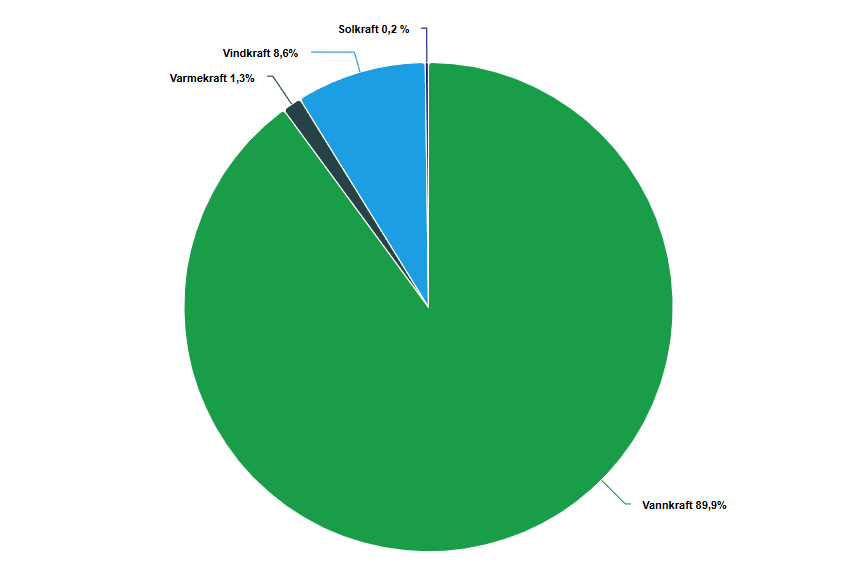
Norway's energy mix in 2025.Ill. SSB
Regional Differences and Changes in the Energy Mix
Despite the record national result, there were significant regional differences. In the southern price zones NO1, NO2, and NO5, hydropower production fell by 3 percent. In central and northern Norway, that is, in zones NO3 and NO4, it increased by 23 percent.
Wind power production amounted to 13.9 TWh, which was 4.4 percent lower than in 2024. Thermal power production dropped by 11.5 percent to 2.1 TWh. Solar energy increased to 345.9 GWh, but still accounted for only 0.2 percent of total production.
Wind power production amounted to 13.9 TWh, which was 4.4 percent lower than in 2024. Thermal power production dropped by 11.5 percent to 2.1 TWh. Solar energy increased to 345.9 GWh, but still accounted for only 0.2 percent of total production.
Record electricity production resulted in the highest net electricity exports in history. In 2025, it reached 22.8 TWh. At the same time, household energy consumption fell to 40.4 TWh, partly due to higher average air temperatures.
How do you rate this article?