Norway is spending record amounts on the military? Years ago, the fear was greater
Norway is rapidly increasing its defense spending. According to the Central Bureau of Statistics (SSB), support for Ukraine plays a significant role. In 2024, the world allocated an average of 2.5% of GDP to defense, but in the past, the level was higher.
After the end of the Cold War and the fall of the Berlin Wall in 1989, the share of defense spending began to decline.
Fot. Adobe Stock, licencja standardowa (zdjęcie poglądowe)
SSB points out that defense spending changes with wars, international tensions, GDP levels, and economic crises. In the early 1960s, the world could allocate over 6% of GDP to defense. Currently, the increase is mainly visible within NATO. The alliance assumes that member states should reach at least 3.5% of GDP in direct defense spending by 2035.
Norway accelerates after 2022
Norway is on track to achieve NATO's goal. Spending increased in 2023, 2024, and especially in 2025. SSB indicates that aid to Ukraine had a major impact. Without this support, the share of defense spending in Norway's GDP in 2025 would be similar to the level from the mid-1990s.
In European NATO countries and Canada, including Norway, defense spending rose from 1.4% of GDP in 2014 to 2.3% in 2025. The US still allocates a larger share of GDP to defense than most allies. However, its share of total NATO spending dropped after 2021. In 2025, it was just below 62%.
In European NATO countries and Canada, including Norway, defense spending rose from 1.4% of GDP in 2014 to 2.3% in 2025. The US still allocates a larger share of GDP to defense than most allies. However, its share of total NATO spending dropped after 2021. In 2025, it was just below 62%.
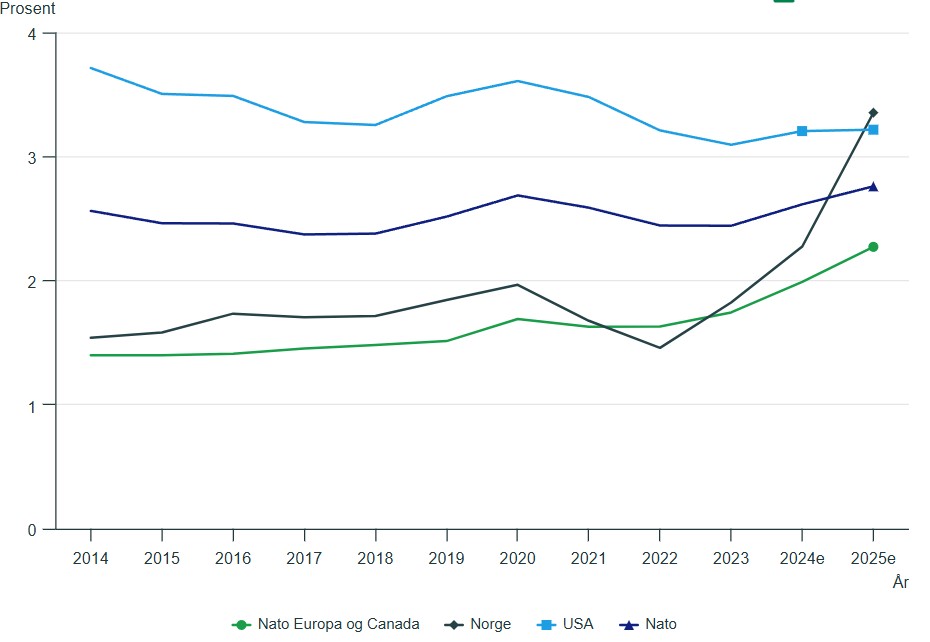
Defense spending as a percentage of GDP for NATO and selected countries. Data for 2024 and 2025 are estimates and refer to expenditures. GDP is given in 2021 prices.Ill. SSB
The world spent more during the Cold War
In the early 1970s, NATO allocated a larger share of GDP to defense than today. In 1970, it was 6.7% for the entire Alliance. The US had 8.7% at that time. Norway reached 4.1% of GDP.
After 1980, the share of spending began to decline. The end of the Cold War and the fall of the Berlin Wall in 1989 had an impact. SSB also points to the so-called peace dividend, meaning the possibility of reallocating part of public funds to other purposes. In Norway, defense was the sixth largest category of public spending both in 1995 and in 2024.
After 1980, the share of spending began to decline. The end of the Cold War and the fall of the Berlin Wall in 1989 had an impact. SSB also points to the so-called peace dividend, meaning the possibility of reallocating part of public funds to other purposes. In Norway, defense was the sixth largest category of public spending both in 1995 and in 2024.
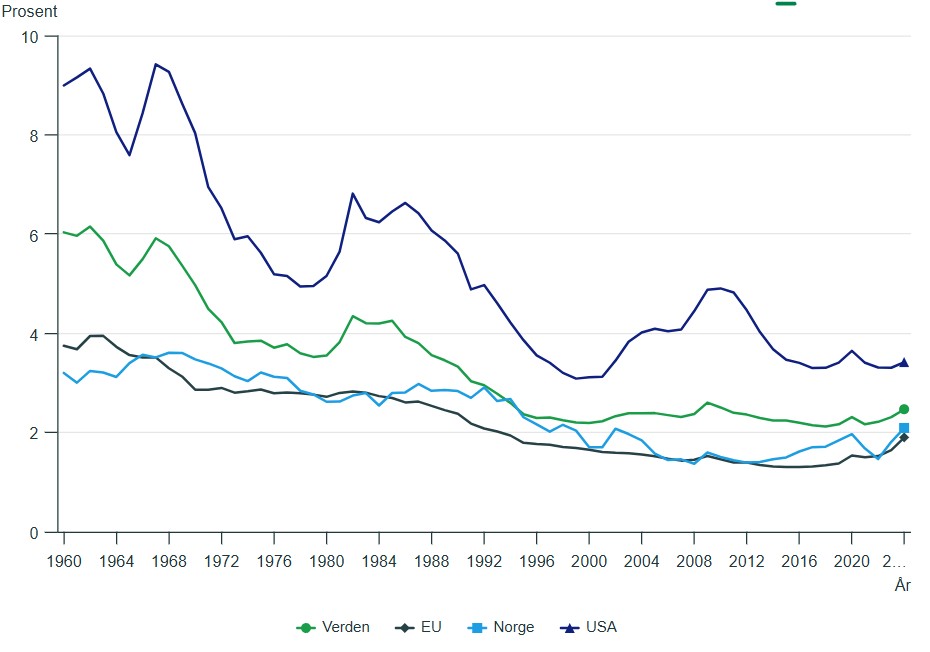
Defense spending as a percentage of GDP worldwide, in the EU, Norway, and the USA.Ill. SSB
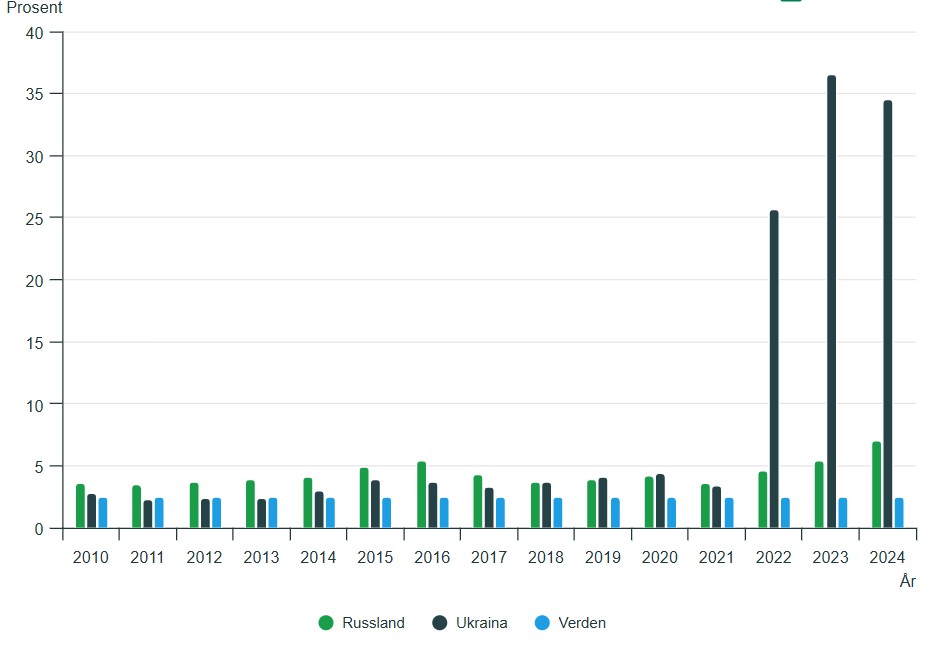
Defense spending as a percentage of GDP worldwide, in Russia, and in Ukraine.Ill. SSB
Global data is less certain than NATO data, but shows a similar trend. Spending increased during periods of tension, including the Vietnam War, after the Soviet invasion of Afghanistan, after the 2001 attacks, and after the start of the full-scale war in Ukraine in 2022. In 2021, global defense spending was below 2.2% of GDP. In 2024, it approached 2.5%. In Ukraine, the scale was much larger: in 2022, defense spending reached 25% of GDP, and in 2023–2024 it hovered around or exceeded 35%.
How do you rate this article?