Fuels and electricity cooled inflation. Food prices went the other way
Inflation in Norway fell to 3.4 percent year-on-year in April. The pace of price growth was slowed by fuels and electricity. At the same time, food, non-alcoholic beverages, and exported industrial goods became noticeably more expensive.

Food has clearly become more expensive.
Fot. Adobe Stock, licencja standardowa
The Consumer Price Index (CPI) rose by 3.4 percent from April 2025 to April 2026. This is 0.2 percentage points less than in March. From March to April, prices increased by 0.4 percent. Analysts surveyed by Bloomberg expected inflation at 3.5 percent, so the reading was slightly lower than forecast.
Energy slowed the pace of price growth
In April, energy prices behaved differently than the previous month. In March, electricity and fuels drove inflation up. In April, they slowed it down. According to Espen Kristiansen from SSB, one of the reasons was the reduction in fuel charges. The changes came into effect on April 1.
Fuel and lubricant prices fell by 10.6 percent from March to April. This followed a record strong increase the previous month. Electricity prices, including grid charges, fell by 0.9 percent. In the same period a year earlier, they had risen by 7.3 percent. This reduced the annual CPI growth rate.
Fuel and lubricant prices fell by 10.6 percent from March to April. This followed a record strong increase the previous month. Electricity prices, including grid charges, fell by 0.9 percent. In the same period a year earlier, they had risen by 7.3 percent. This reduced the annual CPI growth rate.
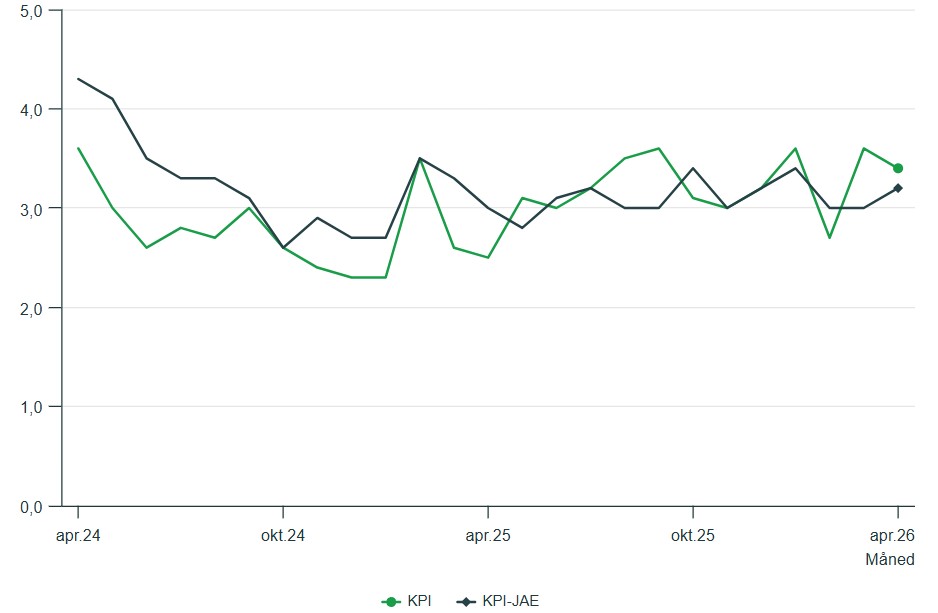
Change over 12 months.Ill. SSB
Food drove up core inflation
CPI-JAE, the index adjusted for tax changes and excluding energy, rose by 3.2 percent year-on-year. This is 0.2 percentage points more than in March. It was the first increase in the index's pace since January. Food prices had the biggest impact. They were 6.1 percent higher than a year earlier.
Food and non-alcoholic beverage prices rose by 2.9 percent from March to April. Year-on-year, they were 6.6 percent higher. SSB points to the effect of Easter. This year, holiday promotions mainly took place in March, while last year they were in April. Stein Rømmerud from Norgesgruppen told E24 that data from these two months should be interpreted with caution.
In April, food prices rose by 2.8 percent compared to March. The previous month, they had fallen by 2.6 percent. According to Kristiansen, in April they returned to roughly the level seen in February. The increase covered most food groups. Non-alcoholic beverages became 3.9 percent more expensive from March to April.
Food and non-alcoholic beverage prices rose by 2.9 percent from March to April. Year-on-year, they were 6.6 percent higher. SSB points to the effect of Easter. This year, holiday promotions mainly took place in March, while last year they were in April. Stein Rømmerud from Norgesgruppen told E24 that data from these two months should be interpreted with caution.
In April, food prices rose by 2.8 percent compared to March. The previous month, they had fallen by 2.6 percent. According to Kristiansen, in April they returned to roughly the level seen in February. The increase covered most food groups. Non-alcoholic beverages became 3.9 percent more expensive from March to April.
Some products drive inflation, others slow it down
Among specific products, chocolate stood out. Its prices rose by 19 percent in April month-on-month and were 13 percent higher than a year earlier. Citrus fruits were 31 percent more expensive than a year ago. The annual price growth for coffee was 30.8 percent. Nine out of more than 100 SSB product groups had negative price dynamics, including yogurt, pizza, and pasta.
Some categories limited price growth. Air tickets were 12.8 percent cheaper than a year earlier. The shift in Easter had an impact. In 2025, it fell in April, when more people traveled. Inflation was also slowed by furniture, household goods, and IT equipment, partly due to promotional campaigns.
Some categories limited price growth. Air tickets were 12.8 percent cheaper than a year earlier. The shift in Easter had an impact. In 2025, it fell in April, when more people traveled. Inflation was also slowed by furniture, household goods, and IT equipment, partly due to promotional campaigns.

In March, the annual price growth for food and non-alcoholic beverages was 1.6 percent; in April, it rose to 6.6 percent.Photo: stock.adobe.com/standard license
Industrial prices more stable domestically than in exports
On the domestic market, industrial prices rose more steadily than in exports. In April, the annual price growth of goods sold domestically was 6.6 percent. SSB data indicate that exports are more dependent on global commodity markets. Events in the Middle East also played a role. Export prices rose despite the strengthening of NOK against other currencies.
Oil and gas extraction was 35.5 percent more expensive than a year earlier. From March to April, prices in this category, however, fell by 4.4 percent. This decline reduced the overall PPI by 0.5 percent month-on-month. In the energy supply sector, prices fell slightly in April. However, they were about 46 percent higher than a year earlier.
Oil and gas extraction was 35.5 percent more expensive than a year earlier. From March to April, prices in this category, however, fell by 4.4 percent. This decline reduced the overall PPI by 0.5 percent month-on-month. In the energy supply sector, prices fell slightly in April. However, they were about 46 percent higher than a year earlier.
How do you rate this article?