Norway lost to England 1:2. Better not mention this to a Norwegian on Monday
It was a big loss, but not a humiliation. Norway took the lead, fought until extra time, had a goal disallowed, and created several chances that the country will now watch frame by frame. For Poles working in Norway, Monday comes with a simple instruction: show respect, let Norwegians vent about VAR, and don’t start with the words 'it’s just a game.'
Someone who doesn't know much about football can use a safe phrase: Det var surt, men Norge hadde et fantastisk VM. Translation: It was tough, but Norway had a great World Cup.
MN
In short
- Norway lost to England 1:2 in the World Cup quarterfinals.
- Norwegians were hoping for their first-ever semifinal.
- The great Norwegian “Ro!” united fans across the country and abroad.
- Controversial referee decisions will be a hot topic at work.
- Poles should show respect and avoid controversial statements.
- Norway has gained new faith in its national team.
A big loss, because the hope was big
Norway was eliminated from the World Cup after a 1:2 defeat to England. Andreas Schjelderup gave Norway the lead, but Jude Bellingham first equalized before halftime and then scored the winning goal in extra time. Even England’s coach, Thomas Tuchel, admitted after the match that his team was quite lucky.
And that’s exactly why this result hurts so much.
The Norwegians were not crushed. They didn’t go out after a poor game. For long stretches, they were at least equal to England. They had the lead, chances for a second goal, and hope for their first-ever World Cup semifinal.
It’s also important to remember the bigger picture. Norway returned to the World Cup after 28 years, reached the quarterfinals for the first time, and along the way beat Brazil. Even before the match against England, the whole country believed this team could really make it to the final.
So it was a big defeat only in one sense: the dreams were big. In sporting terms, Norway has nothing to be ashamed of.
The rowing only ended at the palace
Before the quarterfinal, we described the great Norwegian “Ro!” on MojaNorwegia. Fans in stadiums, squares, streets, and even the subway sat on the ground and performed a rowing motion together. The national team gave Norwegians something they had lacked for years: a shared football celebration.
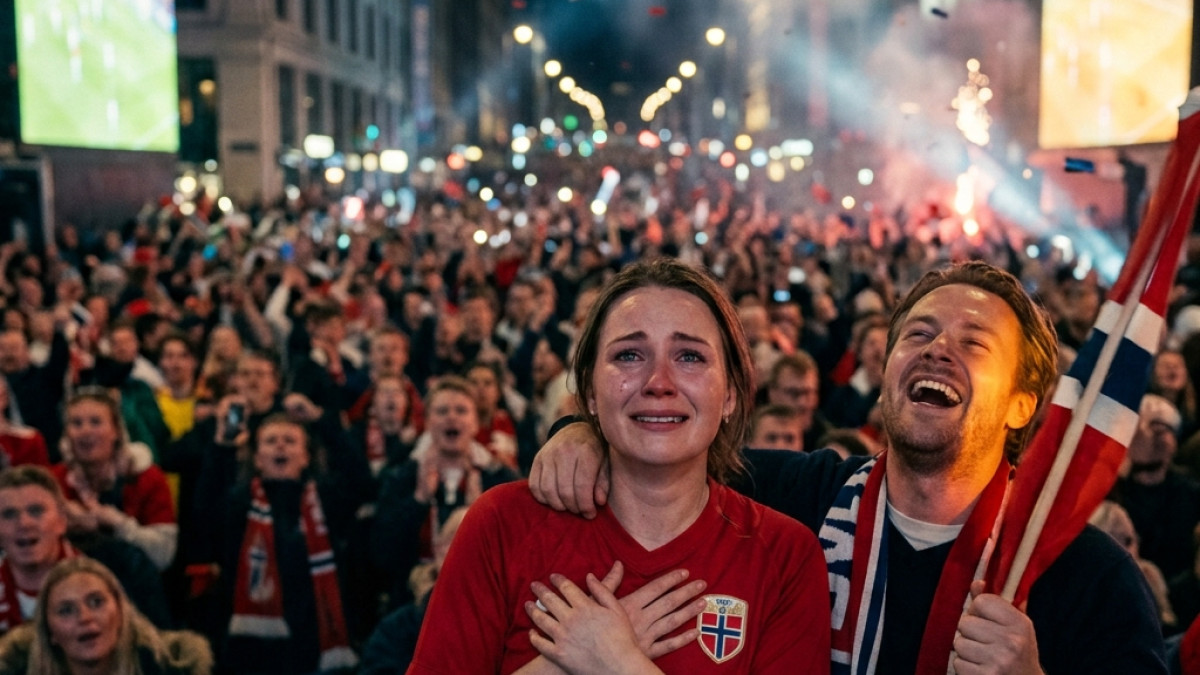
About 22,000 people came to watch the match at Frogner Stadium. After the final whistle, people didn’t go straight home. Around 2 a.m., thousands of fans headed to the Royal Palace for one last communal “rowing.” According to police, as many as 20,000 people gathered in front of the palace.
This is an important image of this defeat. There were tears and anger, but no turning away from the team.
Norwegians didn’t say goodbye to the losers. They thanked the team that gave them the most exciting football weeks in a generation.
Four topics that will come up over coffee
On Monday, the coffee machine might become a second VAR studio. In many Norwegian companies, conversations will revolve around four situations.
The first is the now-famous camera cable. Norwegian players and staff claim the ball hit it before Bellingham’s equalizer. If that were true, the referee should have stopped play. FIFA responded that the sensor in the ball showed no contact. The problem is, later graphics and footage have raised doubts again.
The second situation is Norway’s disallowed goal. The referees saw a foul by Haaland, though many Norwegian fans still don’t understand exactly why the goal was taken away.
The third is Alexander Sørloth’s play. With Norway leading 1:0, they launched a very dangerous attack. Sørloth could have passed to Haaland but chose to finish himself. He didn’t score, and a few minutes later England equalized. Norwegians will be replaying this situation many times—on phones, in canteens, and at barbecues.
The fourth is Ørjan Nyland’s mistake on England’s winning goal. It’s easy to forget that just a few days earlier, the same goalkeeper was one of the heroes in the win over Brazil. One mistake doesn’t erase the whole tournament.
Poles know this kind of sports talk well. “If only he had passed.” “If only the referee had seen it.” “If only the goalkeeper had caught it.” On Monday, you won’t need perfect Norwegian to join this part of the conversation.
What can Poles expect at work?
There won’t be a national day of mourning. Construction sites will open, ferries will depart, and computers will be turned on as usual. The match was on Saturday evening, so Norwegians had all Sunday to sleep, have family dinner, and watch the controversial moments about 47 times.
Still, the first coffee break might last a little longer.
Some will argue that Norway was wronged by the referees. Others will say they just needed to take their chances. Still others will shrug and say that reaching the quarterfinals was a huge success.
The best tactic for a Pole? Listen first. You don’t have to pretend to be an expert or explain to Norwegians how their team should play.
It’s also better not to start with: “England was simply better.”
Even the English coach admitted his team was lucky.
Another bad idea: “It’s just a game.”
For people who waited 28 years to play in the World Cup, beat Brazil, and were minutes away from the semifinals, this was not just another game.
It’s also not worth attacking Sørloth. You can criticize his decision on the field, but after the match, he and his partner were bombarded with abusive messages, some even containing death threats. That’s where the sports jokes end.
One sentence in Norwegian is enough
Someone who doesn’t know much about football can use a safe phrase: Det var surt, men Norge hadde et fantastisk VM.
Which means: It was tough, but Norway had a great World Cup.
You can also say: Dere burde være stolte. You should be proud.
And if you want to start a half-hour discussion: Jeg tror ballen traff vaieren. I think the ball hit the cable.
Use the last sentence with caution. It might delay the start of work.
Norway lost the match, but won something bigger
Erling Haaland said after the elimination that this World Cup changed Norway and himself. It’s hard to disagree. For several weeks, strangers talked to each other on buses, thousands gathered in squares, and children saw the Norwegian team compete as equals with the world’s best.
Expectations have changed too. Until now, just qualifying for a big tournament was a success for Norway. Now, fans know their team can beat Brazil and put England on the ropes.
The wait for another big match won’t be long. In September, Norway will start competing in the top division of the Nations League, facing Portugal, Denmark, and Wales.
On Monday, Norwegians will return to work. One will be silent. Another will show the cable video. A third will say Sørloth should have passed. A fourth will remind everyone of the win over Brazil.
And a Pole who says: “Det var surt, men Norge hadde et fantastisk VM” will probably earn more sympathy than someone with an hour-long analysis of defensive tactics.
Because that sentence is not just polite. It’s simply true.
How do you rate this article?