
Expensive electricity ahead of winter. What about Norgespris and data centres in Norway?
In southern Norway, electricity costs significantly more than a year ago, and the energy minister is warning of an expensive winter. In the longer term, prices could be driven up by the growing consumption of data centres. There is also specific news for households: Norgespris for 2027 will have to be ordered again, and the government is proposing a higher rate.
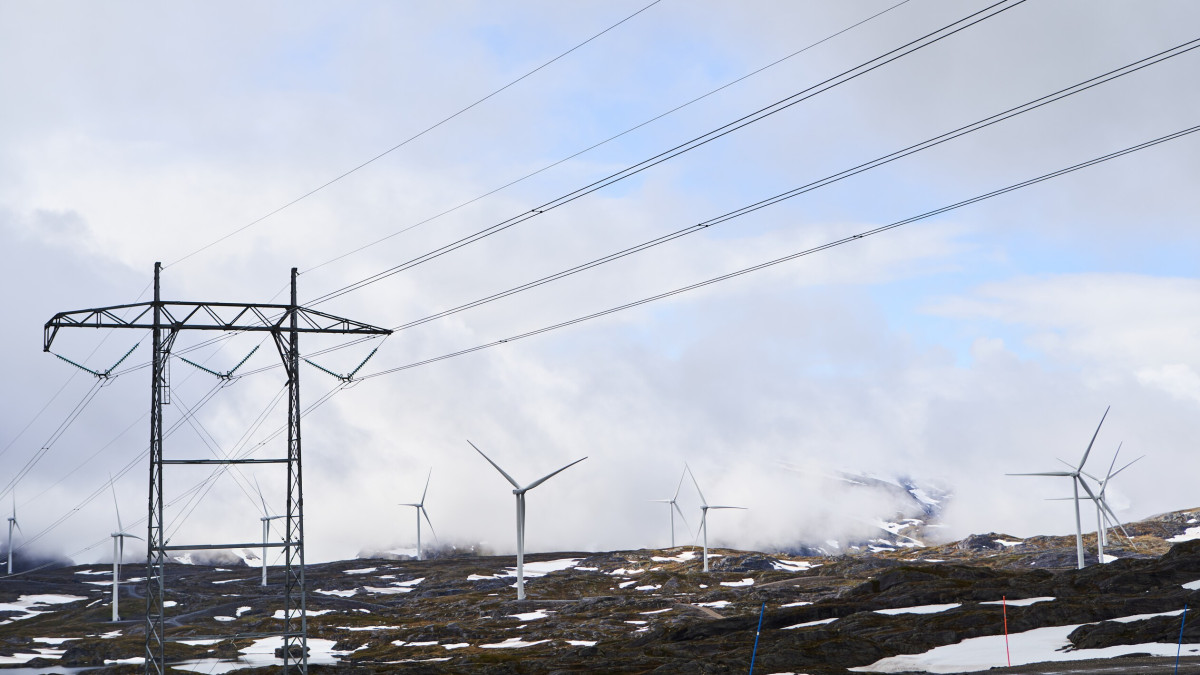
Power lines and wind turbines. Illustrative photo.
Fot. Catchlight/NVE
According to Nord Pool data cited by E24 on 29 October, the average energy price since the beginning of the month in the three southern price zones was 133–146 øre per kWh. In October 2025, it was 56–69 øre. This year's figures do not yet cover the entire month.
These are energy-only prices, before taxes and the grid fee, known as nettleie. They are not the amount everyone will see on their bill: the agreement with the supplier and the use of subsidies or Norgespris also matter.
These are energy-only prices, before taxes and the grid fee, known as nettleie. They are not the amount everyone will see on their bill: the agreement with the supplier and the use of subsidies or Norgespris also matter.
Minister warns of an expensive winter
Energy Minister Terje Aasland spoke at a conference held by NVE, Norway's energy authority, about the likelihood of very high prices in winter. The reasons include low water reserves in Norwegian reservoirs and expensive gas in Europe. More rainfall could improve the situation for hydropower plants.
At the same time, NVE director Kjetil Lund assured that the authority is not concerned about security of supply this winter. Norway can import energy from abroad if necessary. A high price therefore does not mean that households will run out of electricity.
At the same time, NVE director Kjetil Lund assured that the authority is not concerned about security of supply this winter. Norway can import energy from abroad if necessary. A high price therefore does not mean that households will run out of electricity.
Norgespris does not cover the entire bill
The current Norgespris rate is 40 øre per kWh excluding VAT, or 50 øre where VAT is charged. Grid fees, taxes and the supplier's fees, among other things, are paid separately. A standard electricity supply agreement is still required as well.
The scheme covers up to 5,000 kWh per month for a house or apartment and up to 1,000 kWh for a holiday home, per metering point. Consumption above the limit is settled under the agreement with the supplier.
The fixed price provides predictability but does not guarantee the lowest bill. When the market price falls below Norgespris, the participant still pays the fixed rate. Households that do not choose the scheme can use the regular electricity subsidy (strømstøtte) under the applicable rules.
According to preliminary figures from the Ministry of Energy, around NOK 19.8 billion in support was paid out in the first year of Norgespris. The amount includes households and owners of holiday homes.
New enrolment from 5 January. The 2027 price has not yet been set
The current Norgespris period ends on 31 December 2026. The scheme will not be extended automatically. The Ministry of Energy has announced that it will be possible to place new orders from 5 January 2027.
Ordering by the end of 14 January will ensure settlement from 1 January. If the application is submitted later, Norgespris will apply from the date of the order.
The government proposes increasing the rate to 45 øre per kWh excluding VAT, or 56.25 øre including VAT. For now, this is a budget proposal. The final price is to be set by the Storting when it adopts the budget in December.
Data centres could consume more than eight times as much electricity
A separate issue concerns the coming years. In an analysis presented on 29 October, NVE examined how growing energy consumption could affect the market by 2035.
Data centres are large server facilities that support, among other things, internet services. They need electricity both to run their equipment and to cool it. They currently consume around 3 TWh per year. If all projects that have already been allocated grid capacity were built, consumption could reach 25 TWh in 2035. One TWh equals one billion kWh.
Not all planned investments will necessarily be built. However, the scale is large: around half of the capacity reserved for new consumers in the grid is allocated to data centres. This concerns planned connections, not half of the country's current electricity consumption.
What the warning of a 35–55% rise in prices really means
Norway currently produces around 15 TWh more energy in a typical year than it consumes. NVE points out that growing demand combined with too little new generation could eliminate this surplus. In dry years, this would mean greater dependence on imports.
With higher consumption and limited construction of new wind farms, average prices in 2035 could be 35–55% higher than previous estimates for the same year. This is not a forecast that today's bills will increase by that percentage. The NVE analysis shows the effects of different assumptions about consumption and the construction of new energy sources.
A long-term rise in prices is not certain. In an analysis dated 19 October, Statnett, the main transmission grid operator, assumes in its baseline scenario that average prices in southern and central Norway will decline in the coming years. It takes into account, among other factors, cheaper energy in neighbouring countries. The two analyses are based on different assumptions and therefore do not provide one certain future electricity price.
What to check before winter
On your bill, it is worth checking the energy price, supplier fees and nettleie separately. People considering Norgespris can check their own consumption in Elhub and compare how the scheme would have performed against their previous bills. The result of such a comparison concerns the past and does not guarantee future savings.
Current participants should note the reordering deadline: 5–14 January 2027, if they want to keep Norgespris from the beginning of the new year.
Current participants should note the reordering deadline: 5–14 January 2027, if they want to keep Norgespris from the beginning of the new year.
How do you rate this article?