Ukrainians in the Norwegian labor market. Data shows where they are most often employed
Nearly 60 percent of Ukrainians who completed the introductory program in Norway were employed in March 2026. In Tromsø, the employment rate exceeded 75 percent. The data also shows that the professional situation of participants improves over time after completing the program.

Ukrainian refugees are increasingly eager to take up work.
Fot. Pixabay (zdjęcie poglądowe)
The introductory program is designed to prepare refugees for work or study in Norway. According to Statistics Norway (SSB), by the end of 2025, more than 38,000 Ukrainian refugees had completed the program, and just over 32,500 of them were still living in the country in March 2026. About 15 percent of former participants emigrated. The employment rate increased from just under 30 percent in January 2023 to nearly 60 percent in March 2026.
Time after the program matters. Older cohorts work more often
The highest employment rate was recorded among those who completed the program in 2022 and 2023. In March 2026, nearly 70 percent of people from these groups were working, indicating a gradual increase in professional activity over time after leaving the program. Among those who finished the program later, the rate was lower. For participants who completed it in 2024, it was about 60 percent.
Differences are also visible among those who finished the program in 2025. About 55 percent of participants who completed it in the first quarter of 2025 had jobs in March 2026. In the group finishing in the fourth quarter, just over 40 percent were employed. SSB indicates that the share of employed among earlier program participants increased gradually throughout the analyzed period.
Differences are also visible among those who finished the program in 2025. About 55 percent of participants who completed it in the first quarter of 2025 had jobs in March 2026. In the group finishing in the fourth quarter, just over 40 percent were employed. SSB indicates that the share of employed among earlier program participants increased gradually throughout the analyzed period.
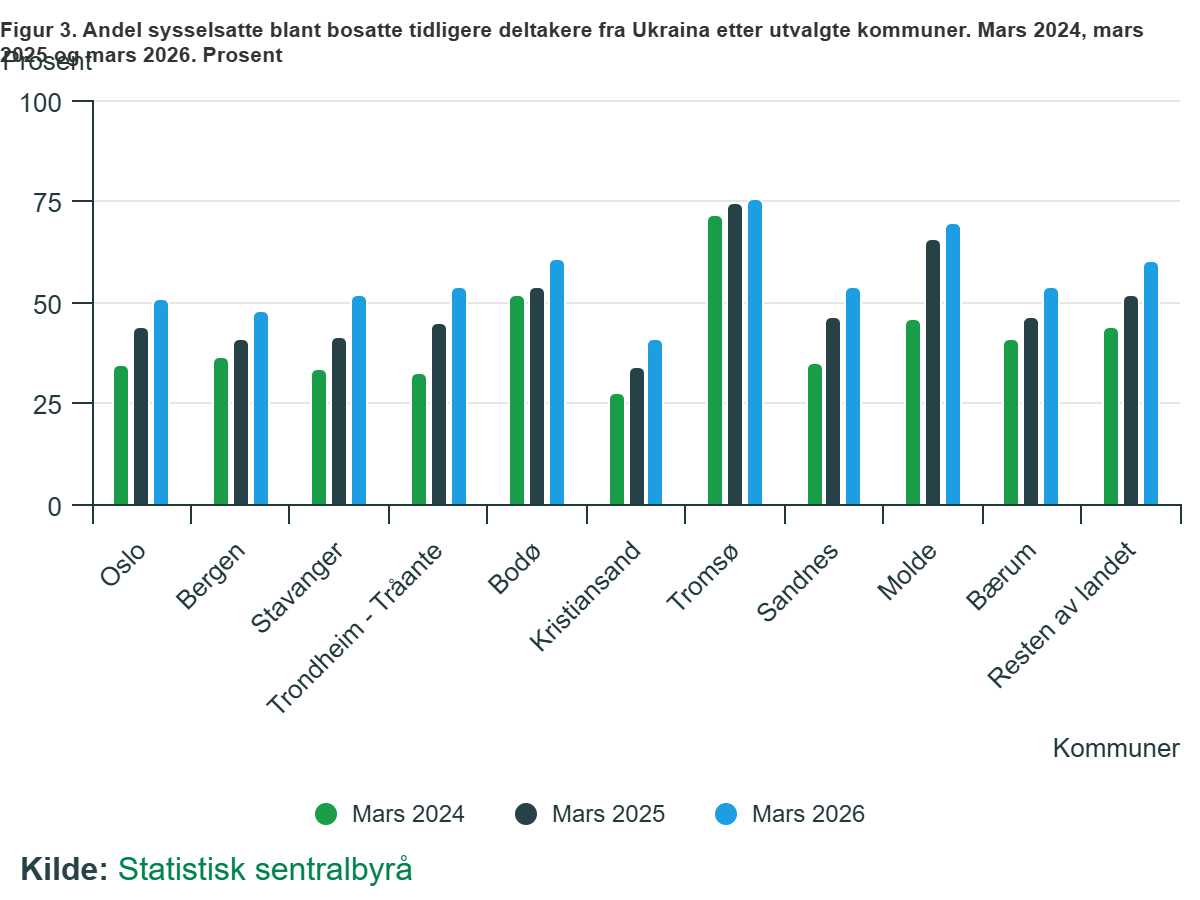
Share of employed among former program participants from Ukraine residing permanently by selected municipalities. March 2024, March 2025, and March 2026.Ill. SSB
Women are catching up with men. Tromsø stands out in employment
The differences between women and men have clearly decreased. In March 2026, just over 60 percent of men and just under 60 percent of women were working, while at the end of 2023, it was about 50 and 40 percent, respectively. There are more women among former program participants. In March 2026, more than 13,000 men and just under 20,000 women from this group lived in Norway.
Clear differences are also seen between municipalities. Among the ten municipalities with the largest number of Ukrainians living there after completing the program, Tromsø had the highest employment rate, exceeding 75 percent. In Oslo and Bergen, about 50 percent of people from this group were working, compared to about 60 percent in the rest of the country. All analyzed municipalities recorded an increase in employment between March 2024 and March 2026.
Clear differences are also seen between municipalities. Among the ten municipalities with the largest number of Ukrainians living there after completing the program, Tromsø had the highest employment rate, exceeding 75 percent. In Oslo and Bergen, about 50 percent of people from this group were working, compared to about 60 percent in the rest of the country. All analyzed municipalities recorded an increase in employment between March 2024 and March 2026.
From January 1, 2026, the rules for the participation of Ukrainians under temporary collective protection in the introductory program changed. Participation became both a right and an obligation, and the program was also extended to people aged 55 to 60. It includes, among other things, learning Norwegian and an element focused on work or education.
How do you rate this article?