
Food prices are falling, but inflation is rising? One factor significantly changed the October data
Electricity prices once again had a major impact on inflation in Norway. In October 2026, the consumer price index was 3.6% higher than a year earlier. At the same time, price pressure related to food and imported goods weakened.

This time, food prices did not affect the CPI index.
Fot. Adobe Stock, licencja standardowa
Statistics Norway (SSB) reported that the consumer price index (CPI) rose by 0.3% from September to October. Annual inflation increased from 3.4% in September to 3.6% in October. Electricity had a significant impact. Although its prices, including grid charges, fell by 0.4% over the month, they were still 12.8% higher than in October of the previous year.
Electricity pushes up inflation. The difference compared with 2025 is substantial
The fall in energy prices was much smaller this year than a year earlier. Between September and October 2025, electricity prices including grid charges fell by 8.3%. SSB indicates that this difference is what increased the annual CPI rate. Last year, prices were affected by the introduction of the Norgespris system and a reduction in the electricity tax.
The situation also varies between regions of Norway. In the northern part of the country, energy prices rose markedly, while very few households there use Norgespris. In central Norway, electricity prices in October 2025 were so low that using Norgespris was not profitable at the time. They have risen since then, making the system more attractive in this region as well. In the southern, western and eastern parts of the country, price developments were different, and some households that switched to Norgespris now pay less than they did a year ago.
The situation also varies between regions of Norway. In the northern part of the country, energy prices rose markedly, while very few households there use Norgespris. In central Norway, electricity prices in October 2025 were so low that using Norgespris was not profitable at the time. They have risen since then, making the system more attractive in this region as well. In the southern, western and eastern parts of the country, price developments were different, and some households that switched to Norgespris now pay less than they did a year ago.
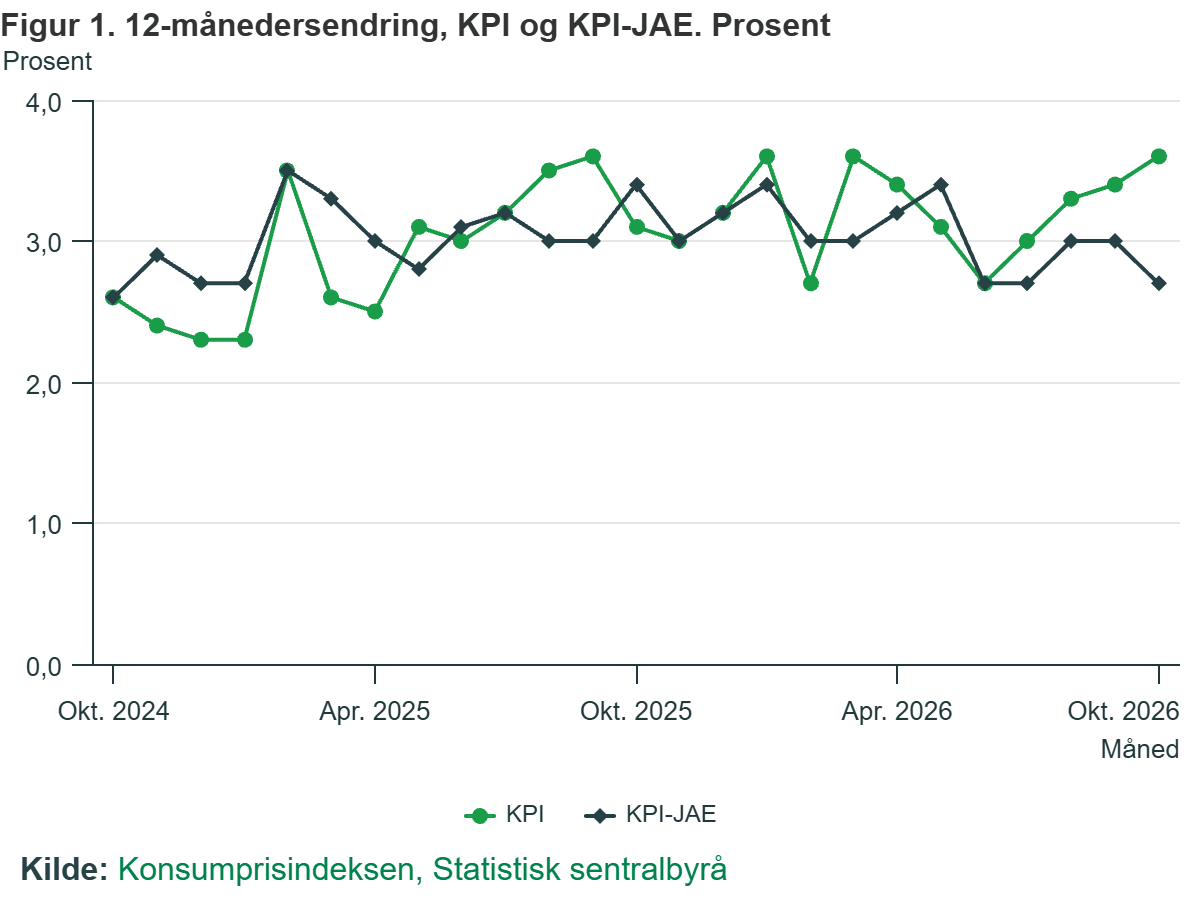
Inflation and core inflation in Norway from October 2024 to October 2026.Fig. SSB
Food prices fall for a third month. Growth in prices of imported goods is also slowing
Excluding energy, inflationary pressure weakened. The CPI adjusted for taxes and excluding energy products, known as CPI-JAE (core inflation), was 2.7% higher in October than a year earlier. This represents a decline in the annual rate of 0.3 percentage points compared with September. SSB indicates that food and imported goods were the main factors.
Food and beverage prices fell by a total of 0.4% from September to October. This was the third consecutive month of declines in this group. Food prices themselves remained unchanged, while non-alcoholic beverages became 2.6% cheaper. Compared with October 2025, food and beverages cost 1.4% more, one of the lowest readings since spring 2022. Imported goods, meanwhile, were 0.7% more expensive than a year earlier, the lowest annual rate recorded since April 2025.
Food and beverage prices fell by a total of 0.4% from September to October. This was the third consecutive month of declines in this group. Food prices themselves remained unchanged, while non-alcoholic beverages became 2.6% cheaper. Compared with October 2025, food and beverages cost 1.4% more, one of the lowest readings since spring 2022. Imported goods, meanwhile, were 0.7% more expensive than a year earlier, the lowest annual rate recorded since April 2025.
Norgespris does not cover all Norwegian households, and some consumers still pay for energy outside the system. At the same time, the impact of electricity prices on inflation depends not only on current rates, but also on price levels in the same month of the previous year. In October, this comparison effect clearly raised the annual CPI index.
How do you rate this article?