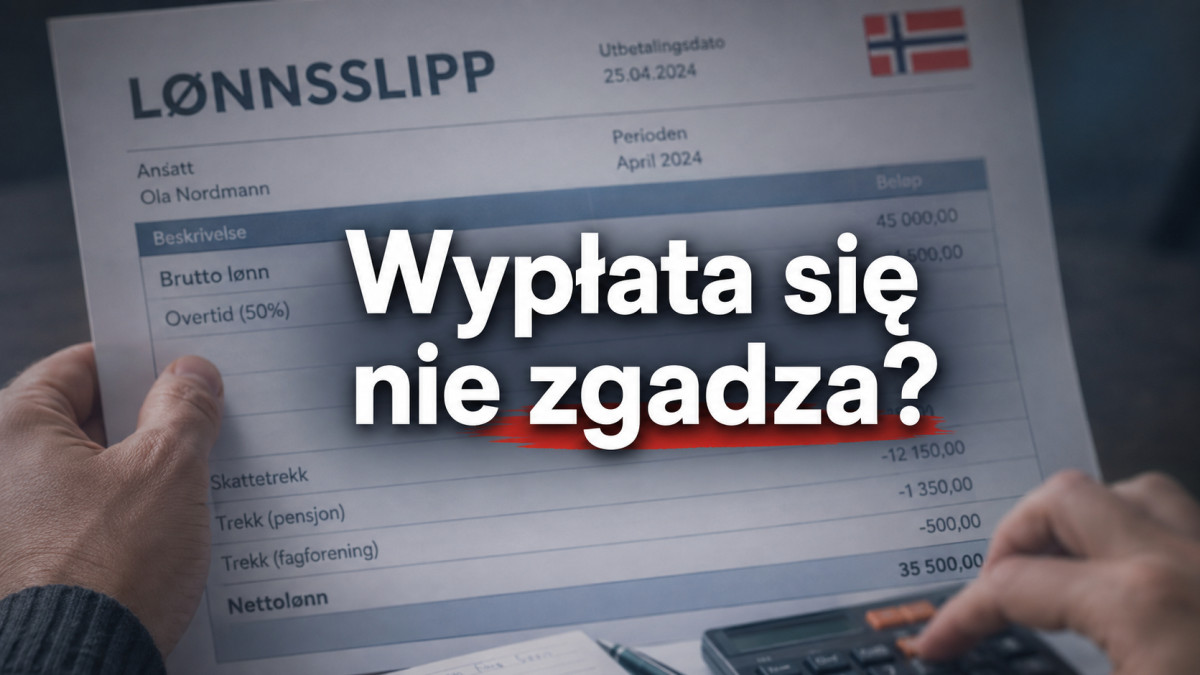
For many Poles working in Norway, a lønnsslipp, or payslip, is a document they look at only to check the “take-home” amount. If the money has arrived in the account, everything appears to be in order.
However, it is precisely on the payslip that you can find the first signs that the salary has been calculated incorrectly.
It is worth checking not only the final amount, but also the number of hours, the rate, overtime, supplements, deductions and tax.
Lønnsslipp – where should you start?
The biggest mistake is comparing only the amount that arrived in your account.
First, compare these three things:
the employment contract + the time actually worked + the lønnsslipp.
It is the difference between them that makes it possible to spot most problems.
The employment contract should specify, among other things, remuneration, the method and date of payment, and information on payment for work performed beyond the agreed working hours. It should also include information on benefits financed by the employer, for example those relating to the pension scheme.
Therefore, if your contract states a specific hourly rate, it is not enough to look at the net amount. You need to check whether that exact rate was applied.
It is also worth comparing the number of hours with your own schedule, time registration system, timesheet or other documentation.
1. Check the number of hours worked
This is one of the most important items.
Did an employee work 172 hours, while the payslip lists 160? The difference does not automatically mean that the law has been broken. It may result, for example, from the payroll period, the way working time is calculated, or when the payroll was closed.
But it needs to be explained.
Particular caution is advisable when the differences occur regularly.
The employer is required to keep records of working time showing the actual time worked by the employee.
That is why it is also worth keeping your own records of hours worked.
This may include:
- a work schedule,
- a photo of the schedule,
- a record of hours on your phone,
- SMS messages or messages from your supervisor,
- emails concerning additional shifts,
- reports from an app used at work,
- timesheets,
- confirmation of entry to a construction site or workplace premises,
- correspondence concerning cover shifts and additional shifts.
Such documents may later be of enormous importance.
In pay disputes, the problem is often not determining the applicable rate itself, but proving how many hours the employee actually worked. Therefore, we advise employees not to rely solely on the employer’s system, but also to keep their own records of working time.~Tomasz Nierzwicki, attorney-at-law, Advokatfirma Nierzwicki & Bluszko AS
2. Hourly rate – is it the same as in the contract?
The next item is the rate.
If your contract specifies, for example, an hourly rate, check whether exactly the same amount appears in the settlement.
Norway does not have one statutory minimum wage applicable to all employees. However, in some sectors there are legally binding minimum rates resulting from generally applicable collective agreements.
Therefore, whether remuneration is correct may depend, among other things, on:
- the sector,
- the employment contract,
- the position,
- the applicable collective agreement,
- the type of work performed.
You should therefore not automatically compare your rate with that of a colleague from another company or sector.
3. Overtime: one of the most common items worth monitoring
Many misunderstandings concern overtid, meaning overtime.
As a rule, the statutory limits for ordinary working hours are 9 hours per 24 hours and 40 hours per 7 days, although in some working-time arrangements the limits are lower, and the regulations also allow certain methods of calculating working time.
For work that constitutes overtime, an employee is entitled to at least a 40 percent supplement to the agreed hourly rate. Contracts or collective agreements may provide for more favourable terms.
For example, the mere appearance on a payslip of an item corresponding to additional hours does not yet mean that everything was calculated correctly. You must also check how the supplement was calculated.
In practice, it is also important to distinguish statutory overtime from work exceeding an individually agreed number of hours. Not every additional hour beyond the schedule is automatically overtime within the meaning of the regulations.
You can also read more about employee rights in this article:
4. Evenings, nights, weekends and holidays – where are the supplements?
An employee sees Saturday, Sunday or a night shift on the schedule and assumes they are automatically entitled to a higher rate.
It does not always work that simply.
Supplements for working evenings, nights, weekends or other special hours may arise primarily from the employment contract, the company’s internal rules or a collective agreement.
Therefore, when checking your pay, compare the lønnsslipp not only with the schedule, but also with the provisions of the contract.
If an employee has worked shifts for several months and the same supplement is missing each time, it is difficult to treat the matter as a single accounting error.

How to read a lønnsslipp?AI illustration
5. Deductions from pay – the employer cannot simply “take money off”
On a lønnsslipp, all items marked with a minus sign are worth checking especially carefully.
An employee may see a deduction for, for example:
- equipment,
- tools,
- clothing,
- an advance payment,
- a car,
- accommodation,
- damage,
- an alleged overpayment of earlier wages.
Not every such deduction is automatically permitted.
The basic rule is that an employer cannot freely deduct money from wages or feriepenger. The deduction must have an appropriate legal basis, result from a collective agreement, or meet the requirements relating to a written agreement. For certain deductions concerning a specific situation, a general clause included earlier in the contract may not be sufficient.
There are, of course, also deductions resulting from decisions by competent authorities, such as utleggstrekk, which the employer may be required to make regardless of the employee’s consent.
Therefore, not every amount labelled “trekk” is an error. But every unclear item should be explained.
A common mistake is assuming that because the employer entered a deduction on the payslip, they automatically had the right to make it. The description on the lønnsslipp alone does not determine whether the deduction is lawful. Its basis and the circumstances of the specific case must be examined.~Tomasz Nierzwicki, attorney-at-law, Advokatfirma Nierzwicki & Bluszko AS
6. Skatt – high tax does not always mean an employer error
Another source of doubt is skattetrekk, meaning the tax deducted from remuneration.
The employer withholds an advance payment according to the information in the employee’s tax card. In the absence of an appropriate tax card, special withholding rules may apply.
Therefore, if net pay suddenly becomes noticeably lower, it is worth checking:
- gross pay,
- the number of hours,
- supplements,
- the amount of tax withheld,
- your current tax card.
Sometimes the remuneration itself has been calculated correctly, and the issue concerns tax settings.
You should therefore not start a pay dispute merely by saying: “This month I received much less in my account.”
First, you need to determine why.
7. Per diem allowance and kilometergodtgjørelse – they are not always part of ordinary pay
Mobile workers often also receive various types of expense reimbursements.
This may include, for example:
- kilometergodtgjørelse – reimbursement for using a private car,
- travel costs,
- per diem allowance,
- accommodation,
- other costs related to performing work away from a fixed location.
Here, the rules applicable at the specific employer, the contract, internal regulations, any collective agreement and the nature of the travel are particularly important.
You should therefore not assume that every employee is automatically entitled to a specific per diem allowance or kilometergodtgjørelse in every situation.
However, if reimbursement results from agreed employment terms and the employee regularly incurs costs without receiving the amounts due, it is worth collecting, among other things:
- reiseregning,
- a mileage record,
- receipts,
- route information,
- travel assignments,
- emails and messages from the employer.
8. What about pension?
When analysing remuneration, it is easy to forget about money that the employee does not immediately see in their account.
This includes occupational pension.
Most employers meeting the statutory conditions must have an obligatorisk tjenestepensjon – OTP scheme. In common contribution-based schemes, the minimum contribution is 2 percent of the basis subject to the savings obligation.
However, this does not mean that checking OTP consists solely of looking for one specific item on the payslip.
It is also worth checking the information contained in the contract and the employer’s pension agreement itself.
Do you work as a vikar or ringevikar? Check your pay particularly carefully
With a fixed monthly salary, it is easier to notice a change.
It is more difficult when the number of hours changes every month, the employee receives extra shifts or works on call.
Then a difference of a dozen or so hours may disappear among the many items on the payslip.
It is particularly worthwhile comparing: schedule → your own record of hours → lønnsslipp → bank transfer.
One error or already a legal problem?
Not every difference on a payslip means you need to contact a lawyer immediately.
The issue starts to look more serious when:
- successive payments do not add up,
- the employer does not respond to questions,
- payment is missing for hours worked,
- overtime regularly disappears,
- the applied rate differs from the agreed one,
- unclear deductions appear,
- the employer refuses to provide a lønnsslipp,
- the employer’s record of hours differs from reality,
- the employee reports an error, but subsequent payments are still calculated the same way.
In that case, the matter should not be put off.
A one-off difference can often be explained with the HR department or payroll office. However, if the same problem occurs month after month, or the employer does not want to explain how the pay was calculated, it is worth securing the documents and assessing whether the employee has a claim for payment.~Tomasz Nierzwicki, attorney-at-law, Advokatfirma Nierzwicki & Bluszko AS
What should you do if your pay does not add up?
The worst solution is to limit yourself to a verbal conversation: “Boss, I think I’m missing some money.”
If the matter continues for longer, after a few months each party may remember the course of the conversation differently.
It is therefore better to act step by step.
Step 1. Check the documents
Prepare:
- arbeidsavtale,
- lønnsslipp,
- work schedule,
- timesheets,
- bank transfers,
- messages concerning additional shifts,
- travel and expense documentation,
- previous payslips.
Step 2. Calculate the specific difference
Instead of writing: “I think my pay is too low,” it is better to state: “According to my records, I worked X hours, but I was paid for Y hours.”
The more specific the report, the easier it is to establish the cause.
Step 3. Report the problem in writing
An email or another form that allows you to retain a copy of the correspondence makes it possible to document:
- when the issue was reported,
- what it concerned,
- which amount or period it concerned,
- what the employer’s response was.
Step 4. Keep the employer’s response
Do not delete emails, SMS messages or other messages.
What today seems like an ordinary exchange of words with a supervisor may later be important evidence.
Step 5. If the issue is not resolved – assess further action
In some cases, it may be necessary to formally pursue the remuneration due.
Arbeidstilsynet can provide information concerning employee rights, but the authority itself points out that it does not have the power to resolve all private-law disputes between employees and employers.
Therefore, in a dispute over a specific amount due, proper preparation of the claim and documentation may be important.
Have you not received any pay at all?
This is a situation that definitely should not be ignored.
Norwegian regulations treat non-payment of remuneration due very seriously; Arbeidstilsynet also indicates that knowingly failing to pay wages due may constitute lønnstyveri, the criminal offence of wage theft.
If the issue specifically concerns feriepenger, you can also read:
What to do if an employer does not pay feriepenger in Norway?
In turn, people running a business who have trouble recovering money owed by a contractor will find more information here:
How to recover money in Norway? A practical guide for entrepreneurs
The most important rule: check every lønnsslipp
Checking your remuneration does not require knowledge of all Norwegian labour law.
To begin with, just a few minutes each month is enough.
Check:
- Is the number of hours correct?
- Is the rate correct?
- Have the overtime and supplements due been calculated?
- Do you understand all deductions?
- Is the skattetrekk correct?
- Have you received the agreed expense reimbursements?
If something looks different than in previous months, ask why.
Because one mistake may be an error.
But if hours, supplements or other amounts due regularly disappear from your pay, the total after several months may be much higher than the employee initially assumed.
Do you need legal assistance with a pay matter in Norway?
Cases involving incorrectly calculated pay often start innocently: a few hours do not add up, an overtime supplement is missing, or a deduction appears on the lønnsslipp that the employee does not understand.
The problem arises when the differences recur over subsequent months, the employer cannot explain how the salary was calculated, or refuses to pay the amounts due.
In such matters, not only the payslips themselves may be important, but also the employment contract, schedules, timesheets, working-time records, correspondence with the employer, bank transfers, overtime documentation, and the rules regarding supplements and deductions.
The earlier the documents are secured, the easier it will be later to reconstruct the actual course of employment and determine whether remuneration was calculated correctly.
If your lønnsslipp does not add up, you are missing payment for hours or overtime, the employer has applied an unclear deduction, or for some time you have been receiving less than follows from your contract and the work you actually performed – contact
Advokatfirma Nierzwicki & Bluszko AS.
The law firm assists Poles living and working in Norway, among other things, in disputes concerning remuneration, employment conditions and other labour-law matters. Knowledge of the Norwegian legal system combined with an understanding of the situation of Polish employees makes it possible to assess not only whether there is actually an error in the pay, but also what actions can be taken to pursue your rights.
Contact us to analyse the documents, determine what causes the difference in remuneration and check whether you are entitled to unpaid amounts.

Advokatfirma Nierzwicki & Bluszko ASAdvokatfirma Nierzwicki & Bluszko AS