Prime Minister Stronger Than His Party. A Surprising Balance of Power in Norway
The Labour Party (Ap) is not currently number one in the polls. Nevertheless, its leader and incumbent prime minister, Jonas Gahr Støre, remains the most popular candidate to head the Norwegian government. In the latest survey, he is ahead of Sylvi Listhaug, even though her Progress Party (Frp) has significantly higher party support.

Jonas Gahr Støre is seen as the best candidate for prime minister even among the electorates of other parties.
Fot. Pontus Höög/Den norske FN-delegasjonen (Flickr.com, CC BY-NC 2.0)
Frp leads in the Nettavisen poll with 31.4 percent. Ap remains far behind at 22 percent. However, the balance of power looks different when voters are asked about the future prime minister. Støre is chosen by 31.9 percent of respondents, compared with 27.3 percent for Listhaug.
Ap weaker in the polls. Støre stronger as a prime ministerial candidate
The gap between support for Ap and Støre's ratings is clear. Vegard Jarness from InFact points out that the prime minister has a much stronger position than the result of his party would suggest. Listhaug, on the other hand, does not benefit to the same extent from Frp's advantage over Ap. However, the difference between the two candidates is not statistically significant.
This disparity is particularly visible among the electorates of other parties. Støre is supported by 59 percent of voters of the Socialist Left Party (SV) and 70 percent of Green Party (MDG) supporters. He is also chosen by 8 percent of Conservative Party (Høyre) voters. Outside her own party, Listhaug receives much weaker results.
This disparity is particularly visible among the electorates of other parties. Støre is supported by 59 percent of voters of the Socialist Left Party (SV) and 70 percent of Green Party (MDG) supporters. He is also chosen by 8 percent of Conservative Party (Høyre) voters. Outside her own party, Listhaug receives much weaker results.
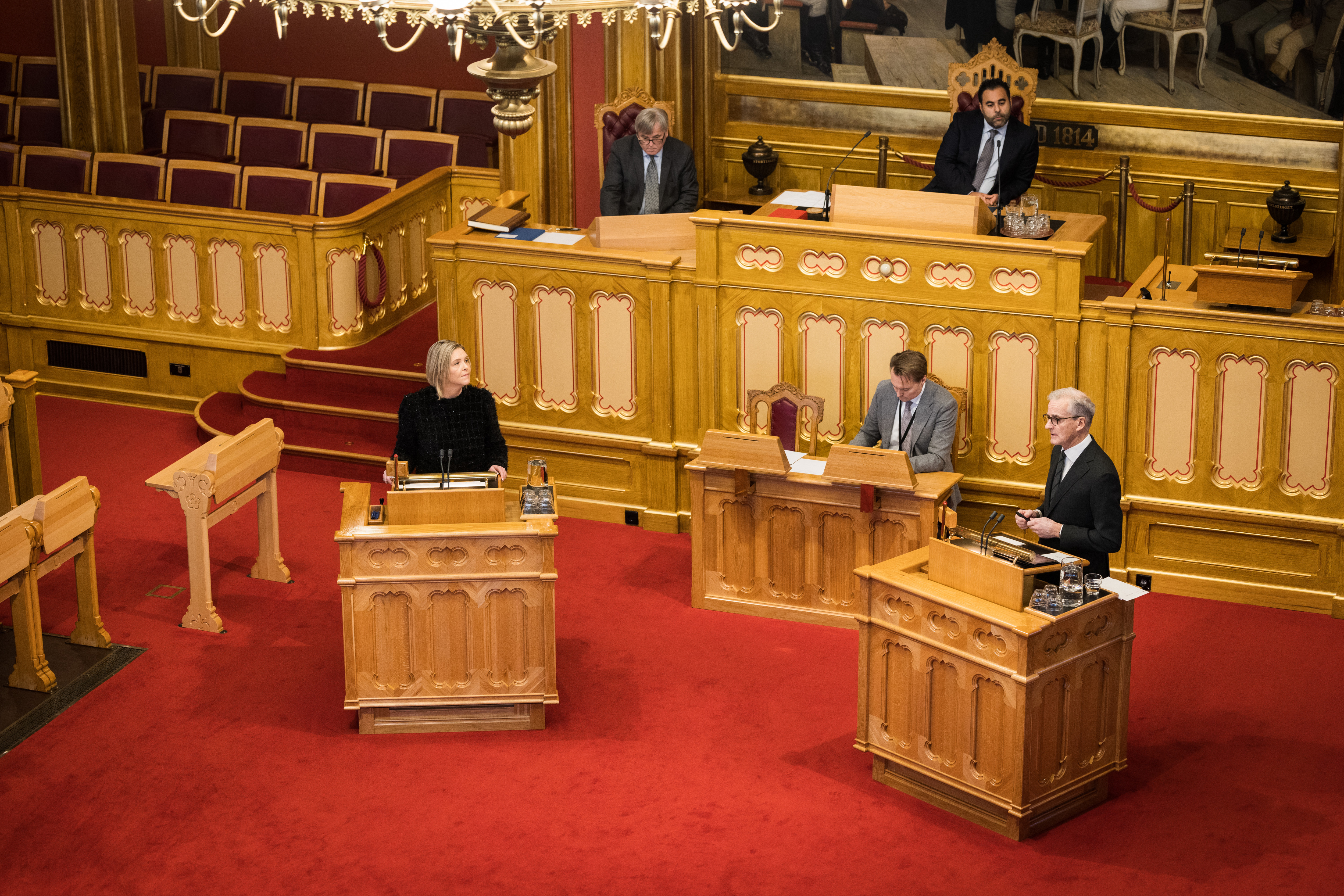
Pictured: Jonas Gahr Støre and Sylvi Listhaug during a session of the Storting.Photo: Peter Mydske/Stortinget
Støre reaches beyond his own electorate. Listhaug strongest within Frp
Among Ap voters, Støre is chosen by 84 percent of respondents. Listhaug has an even higher result within her own party, supported by 87 percent of Frp voters. However, it is Støre who receives more support from people affiliated with other parties. According to Jarness, it is precisely this broader support beyond his own electorate that strengthens his position.
A similar picture can be seen among undecided voters. Støre is chosen by 21 percent of people who do not yet know which party they will vote for. Listhaug is selected by 9 percent of respondents in this group. The survey also shows that Støre is stronger among women and older voters, while Listhaug performs better among men.
A similar picture can be seen among undecided voters. Støre is chosen by 21 percent of people who do not yet know which party they will vote for. Listhaug is selected by 9 percent of respondents in this group. The survey also shows that Støre is stronger among women and older voters, while Listhaug performs better among men.
In third place in the survey is Høyre leader Ine Eriksen Søreide, with 12.5 percent. At the same time, 11.3 percent of respondents choose another candidate, while 17 percent have not yet formed an opinion. This leaves a significant group of voters whose preferences may still change before next year's election.
How do you rate this article?