Electricity prices in Norway have dropped. Without subsidies, they would be the highest since the energy crisis
Electricity prices for Norwegian households fell by 6.6 percent year-on-year in the second quarter of 2026. At the same time, state support increased from 4.8 øre/kWh in the second quarter of 2025 to 55.3 øre/kWh in the same period this year. After including subsidies, households paid an average of 117.9 øre/kWh.
The average price varied for each region of Norway and depended on the chosen contract.
Fot. Adobe Stock, licencja standardowa
The data was published by Statistics Norway (SSB). The total price of electricity, including grid fees and taxes but before deducting state aid, amounted to 173.2 øre/kWh in the second quarter of 2026. The energy itself cost 100.1 øre/kWh. The grid fee was 33.9 øre/kWh, and taxes and other charges were 39.2 øre/kWh.
Support lowers bills. Aid is significantly higher
After deducting state support, the average price for households was 117.9 øre/kWh. This means a decrease of 3.4 percent compared to the first quarter of 2026, when consumers faced higher energy costs. A year earlier, the price was 126.2 øre/kWh. SSB points out that without support systems, a higher price in the second quarter was last recorded in 2022, during the European energy crisis.
The scale of subsidies remains high. In the second quarter of 2026, the average weighted support from the traditional subsidy system and the Norgespris program amounted to 55.3 øre/kWh, compared to 73.1 øre/kWh in the previous quarter. For recipients using Norgespris, the aid was 79.9 øre/kWh, and in the traditional system, 23.4 øre/kWh. At the end of June, the consumption of households covered by Norgespris accounted for just under 58 percent of total household consumption in the country.
The scale of subsidies remains high. In the second quarter of 2026, the average weighted support from the traditional subsidy system and the Norgespris program amounted to 55.3 øre/kWh, compared to 73.1 øre/kWh in the previous quarter. For recipients using Norgespris, the aid was 79.9 øre/kWh, and in the traditional system, 23.4 øre/kWh. At the end of June, the consumption of households covered by Norgespris accounted for just under 58 percent of total household consumption in the country.
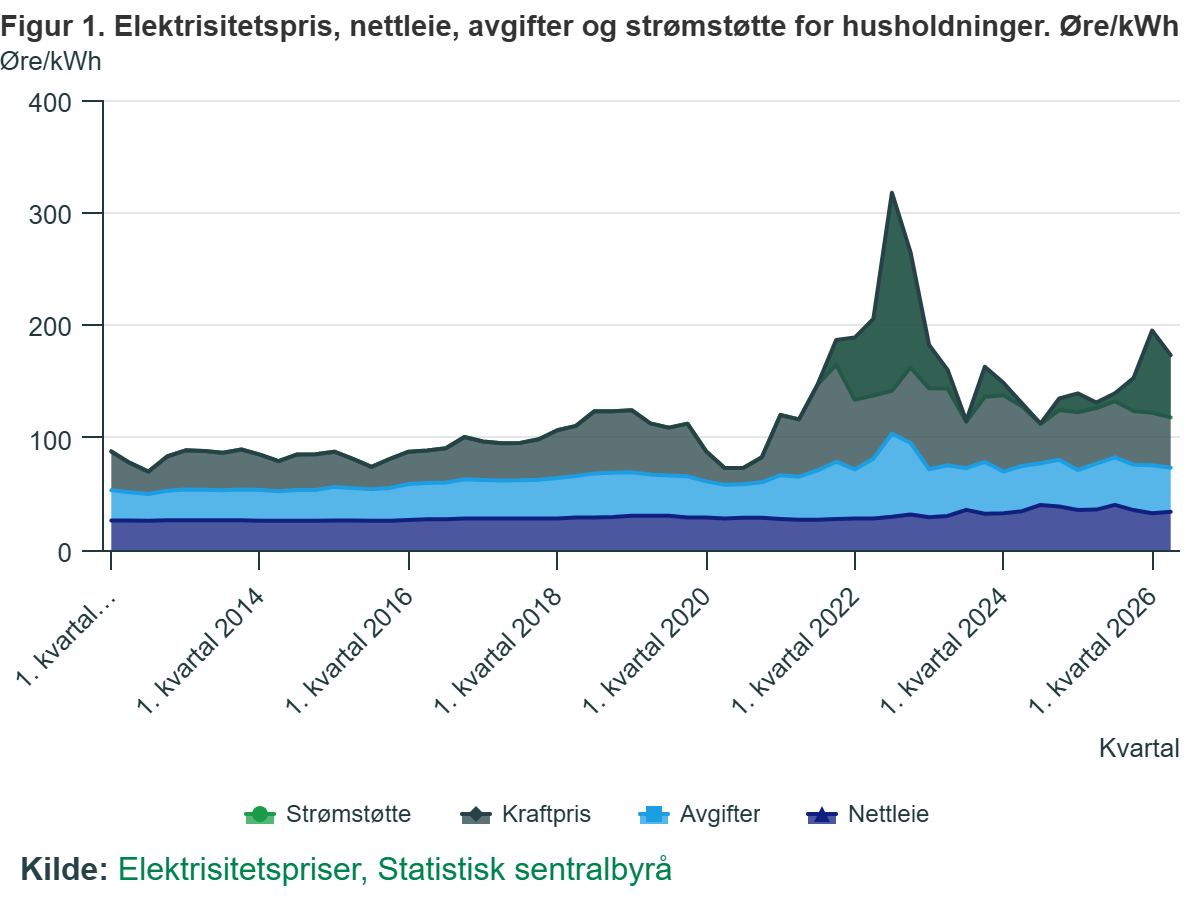
Electricity price, grid fees, taxes, and electricity subsidies for households. Øre/kWhIll. SSB
Spot prices drop quarterly. The south still pays more
Spot prices fell in all Norwegian price areas. Nevertheless, in the southern zones NO1, NO2, and NO5, they were more than three times higher than in the northern zone NO4, which still meant large regional differences. The price level also remained high for this time of year. In the three southern zones, the spot price in the second quarter was the highest for this period since 2022.
The situation was influenced by hydrological conditions. After high hydropower production in 2025, reservoir levels were low, and snow reserves reached record lows. At the end of the second quarter, the average filling of Norwegian reservoirs was about 7 percentage points below the median of the last 20 years. In most of the country, water levels were then the lowest in two decades, while in the north, in the NO4 area, they exceeded previous highs for much of the quarter.
The situation was influenced by hydrological conditions. After high hydropower production in 2025, reservoir levels were low, and snow reserves reached record lows. At the end of the second quarter, the average filling of Norwegian reservoirs was about 7 percentage points below the median of the last 20 years. In most of the country, water levels were then the lowest in two decades, while in the north, in the NO4 area, they exceeded previous highs for much of the quarter.
The way households purchase electricity is also changing. In the second quarter of 2026, contracts linked to the spot price accounted for 97.6 percent of their consumption, while the share of variable price contracts fell to 1.4 percent. The average price of spot contracts was 100.4 øre/kWh, which is 16.8 percent less than the previous quarter, but 86 percent more than a year earlier.
How do you rate this article?