A used EV instead of a diesel? Here’s how to calculate whether buying one pays off in Norway
At 650 Norwegian stations, the price of diesel exceeded NOK 30 per litre in September. At the same time, the market for used electric cars is growing rapidly. At the average Norwegian annual mileage, the difference between filling up with diesel and charging an electric car can range from approximately NOK 6,000 to NOK 15,000 per year. However, the outcome depends primarily on where the driver charges the car. <!--
Category: Guides / Motoring
Publication date: 2026-09-24
Meta title: Used EV or diesel in Norway? Costs in 2026
Meta description: Diesel costs nearly NOK 30 per litre. We calculate when a used EV pays off and what to check before buying a car on Finn.no.
Main image: a used electric car charging at a Norwegian home or against the backdrop of a fuel station; no visible brands
Image caption: The profitability of a used EV is determined not only by fuel prices, but also by where it is charged, insurance and battery condition.
-->
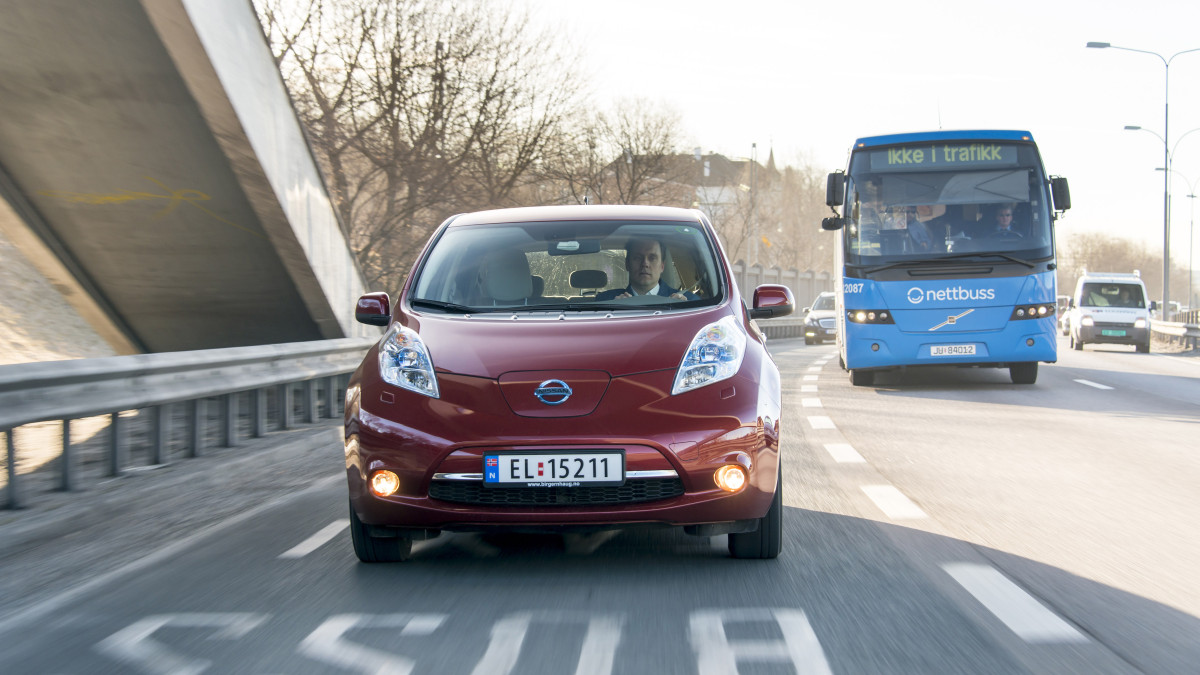
car in Norway
commons.wikimedia.org
The temporary fuel tax cut introduced before Easter expired on 1 September 2026. The reduction amounted to NOK 4.50 per litre of petrol and NOK 4.70 per litre of diesel. After it ended, prices rose quickly. On 18 September, the Drivstoffappen app recorded diesel at no less than NOK 30 per litre at 650 stations. At 34 of them, the price was at least NOK 31, while the average of the collected data reached NOK 28.48 per litre. The increase was also driven by unrest in the Middle East and limited diesel availability. More expensive fuel does not automatically mean that it is worthwhile for everyone to sell their current car. When changing cars, you need to calculate the purchase price, depreciation, charging, insurance, taxes, tolls and real-world winter range.
Used EVs caught up with diesels in the statistics
From January to the end of July 2026, 318,245 changes of ownership of passenger cars were registered in Norway. This was 7.7% more than a year earlier. The number of ownership changes involving electric cars increased by 43.2%, to 103,892, and narrowly exceeded the figure for diesels. However, these figures require clarification. About one in five ownership changes involving an EV in the first half of the year was a technical operation on the financing institution’s side, rather than a normal car sale. After excluding such operations, growth was still around 22%. Among private buyers, diesel has not yet lost first place. In July, it accounted for 34.2% of ownership changes, while EVs accounted for 28.8%. Nevertheless, the market direction is clear: sales of used electric cars to private individuals rose by 8% in July, while diesel sales fell by 5.7%. New EVs became more expensive after the VAT rules changed. Since 1 January 2026, the exemption applies only to the first NOK 300,000 of the price, rather than NOK 500,000 as before. As a result, a car costing NOK 500,000 became approximately NOK 50,000 more expensive. The change does not charge VAT again when a used car is purchased, but it increases interest in the secondary market.
Diesel or electricity: the difference at 11,350 km per year
According to Statistics Norway, a passenger car drove an average of 11,350 km in Norway in 2025. This makes it possible to prepare an illustrative comparison. Assumptions for the calculation:
- the diesel car consumes 6 litres per 100 km,
- a litre of diesel costs NOK 28.48, which was the average recorded by Drivstoffappen on 18 September,
- the EV draws 20 kWh from the grid per 100 km, including charging losses,
- in the example, home electricity costs NOK 1.50 per kWh including additional fees,
- fast charging costs NOK 5.50 per kWh.
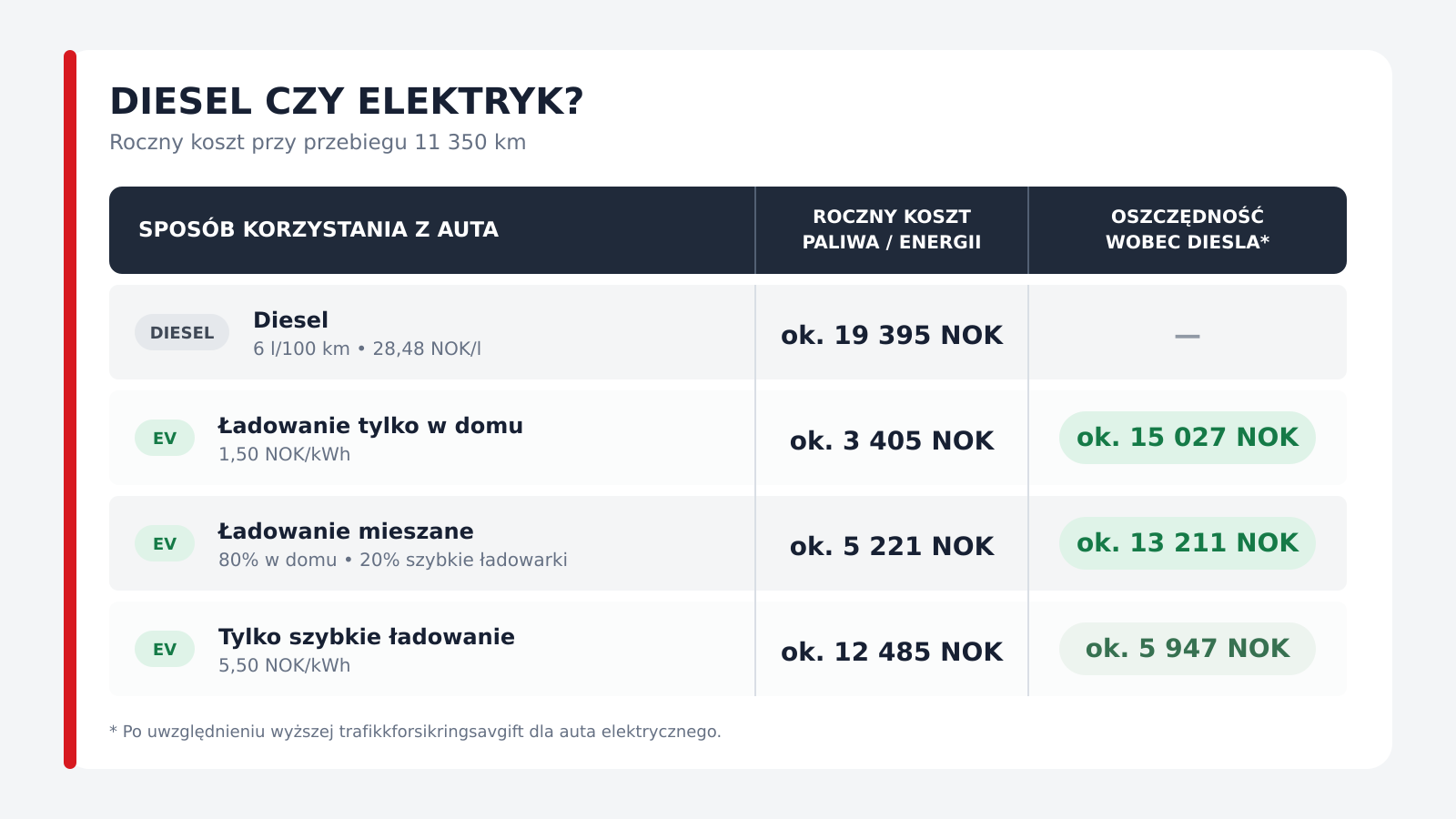
* This concerns the trafikkforsikringsavgift, not the price of the insurance policy. From 1 March 2026, the annual charge is approximately NOK 3,343 for an EV and NOK 2,380 for a petrol or diesel car with a factory-fitted particulate filter. The difference is NOK 963 per year. The calculation does not include the cost of insurance, servicing, tyres, tolls, financing or depreciation. However, it shows why access to a charger at home or work changes the result so significantly. A driver relying almost exclusively on public chargers may still spend less than a diesel owner, but the difference is much smaller.
When a higher car price may pay back
There is no single reliable average price for a used EV. Profitability is best assessed by comparing two specific listings: cars of a similar age, size, mileage, equipment level and technical condition. If the chosen EV costs more than a comparable diesel, the price difference should be divided by the expected annual savings. Based on the assumptions in the table above, the result is as follows:
This is not a forecast of the car’s value, but a simple payback period for the price difference. Before making a decision, deduct any difference in the insurance premium, the cost of installing a home charger and expected financing costs. On the other hand, lower toll charges and more favourable servicing costs for a specific model may improve the result. The simplest formula is: purchase price difference / annual savings after all costs = estimated payback period. If the current diesel is paid off, in good working order and has low annual mileage, changing cars alone may not pay back quickly. People who drive a lot, can charge at home and regularly pass through toll gates have the best chance of a favourable result.
| How much more expensive the EV is to buy | Charging only at home | 80% at home, 20% on the road | Fast chargers only |
|---|---|---|---|
| NOK 30,000 | approx. 2 years | approx. 2.3 years | approx. 5 years |
| NOK 50,000 | approx. 3.3 years | approx. 3.8 years | approx. 8.4 years |
Insurance must be calculated for the specific model
Finans Norge reported that the value of annual premiums for passenger and commercial vehicle insurance rose by 16.2% between the fourth quarter of 2024 and the fourth quarter of 2025. The data cover the entire market and do not mean that every driver’s bill increased by exactly that percentage. Nor is there any basis for assuming in advance one fixed percentage surcharge for every EV policy. The price depends, among other things, on the model, power, vehicle value, cost of parts, place of residence, driver’s age, mileage and claims history. Before signing a purchase agreement, it is best to ask two or three companies for quotes using the registration numbers of both cars being compared. Only the difference between actual offers should be included in the calculation. A separate cost is the trafikkforsikringsavgift, charged together with the policy. From 1 March 2026, the daily rate is:
- NOK 9.16 for an electric car,
- NOK 6.52 for petrol and diesel vehicles with a factory-fitted particulate filter,
- NOK 8.10 for diesel vehicles without a factory-fitted filter.
EVs still pay less at toll gates, but need AutoPASS
Electric cars pay no more than 70% of the rate charged to other vehicles at existing toll gates. Specific amounts vary between cities and routes, so you need to check the places the driver actually travels through. The discount requires a valid AutoPASS agreement. Without one, an EV will often be charged the same rate as an internal-combustion car. For daily commutes through a bomring toll zone, the annual difference may be greater than the savings on servicing, but it will not matter when driving outside tolled sections.
Fast charging can approach the cost of fuel
In 2026, NAF recorded prices from approximately NOK 2 to NOK 7.70 per kWh at Tesla Superchargers. Other operators also have different prices for regular customers, app users and people with subscriptions. The price without an agreement, known as drop-in, is usually around NOK 5–6 per kWh. With consumption of 20 kWh per 100 km, the cost of driving 100 km will be:
- NOK 30 at a home price of NOK 1.50 per kWh,
- NOK 110 at a fast charger costing NOK 5.50 per kWh,
- approximately NOK 171 for a diesel consuming 6 litres at NOK 28.48 per litre.
In winter, do not rely on the official range figure
Winter El Prix 2026 took place in exceptionally low temperatures. For much of the route, thermometers showed between -15 and -25 degrees, while -32 degrees was recorded in Folldal. In such conditions, drivers had to plan charging before completing half of the WLTP range of some tested models. This is not a typical result for every winter journey, but it is a test of extreme conditions. It shows, however, that a resident of a colder region should not select a car for their daily route with only a few kilometres to spare. A heat pump, the ability to warm the car while charging, driving speed, load and battery temperature also matter. During an inspection, establish the real-world summer and winter range. If the seller gives specific values, they can be included in the purchase agreement.
Battery condition matters more than the car’s age alone
In an NAF survey, six out of ten respondents were concerned about the battery when buying a used EV. However, the results of several thousand checks carried out by the organisation are reassuring: the average measured capacity was 92%, and even eight-year-old cars often retained around 90% capacity. This is not a guarantee for every individual vehicle. Most of the cars inspected were around five years old, and individual cars may have damaged modules, cooling system issues or capacity significantly below average. Before buying, check:
- a battery-condition report, preferably stating actual capacity or the SOH indicator,
- the remaining warranty period and the conditions required by the manufacturer,
- faults and differences in voltage between cells detected during the test,
- the operation of the socket, cables, and AC and DC charging,
- real-world summer and winter range,
- service history, underbody damage and any battery repairs,
- the condition of tyres and brakes, which can be costly on a heavy car.
The purchase price is joined by a change-of-ownership fee
For a passenger car with an unladen weight above 1,200 kg, the change-of-ownership fee (omregistreringsavgift) in 2026 is:
- NOK 7,505 for cars first registered in 2023–2026,
- NOK 4,532 for registration years 2015–2022,
- NOK 1,942 for cars from 2014 and earlier.
How to safely buy a car from a private seller on Finn.no
The listing and communication with the seller should remain in Finn’s messenger, so that a record of the arrangements is retained. Before transferring any money, go through the following steps:
- Compare the seller’s identity with the owner listed in the registration certificate. Statens vegvesen recommends checking the seller’s identity document.
- Check for liens (heftelser) in Brønnøysundregistrene. If the car is collateral for a loan, the method of repayment and removal of the lien must be agreed before payment. The seller’s assurance that they will do it later is not enough.
- Check the EU inspection and registration status. Licence plates on the car do not guarantee that the vehicle is currently registered.
- Order a technical report and a battery test. Include in the agreement all identified faults, declared range, equipment, charging cables, mileage and warranty status.
- Sign the agreement before payment. You can use the Forbrukerrådet template or NAF’s digital agreement with BankID identification.
- Take out insurance from the day the ownership change is approved. Having no policy after purchase results in a daily fee for an uninsured vehicle.
- Approve the salgsmelding in your own Statens vegvesen account. The seller sends the notification, and the buyer receives an SMS and logs in to Din side themselves. Do not click payment links sent by the seller.
- Link payment to the change of ownership. NAF’s digital agreement allows Vipps payment and registration of the new owner at the same time. For transactions up to NOK 500,000, NAF does not charge the 1% Vipps fee, although the bank may apply limits and fees.
- Pay the omregistreringsavgift before driving the car. The vehicle cannot be used until the registration change has been completed.
How do you rate this article?